
History Comes Alive at the Cité de l’Histoire


- SUBSCRIBE
- ALREADY SUBSCRIBED?
BECOME A BONJOUR PARIS MEMBER
Gain full access to our collection of over 5,000 articles and bring the City of Light into your life. Just 80 USD per year.
Find out why you should become a member here.
Sign in
Fill in your credentials below.
Meeting Joan of Arc was always going to be awkward. I feared I wouldn’t be able to mask my English accent, so why not just go straight out and tell her I was from the enemy camp and perhaps ask whether it’s, ahem, too late for an apology? Ah les Anglais, she frowned, ca, c’est une longue histoire. Indeed, a very long and often troubled story. Not for nothing is the period when Joan came to prominence known as the Hundred Years War and even that was rounding down, given that its dates were 1337-1453. We smiled. I moved on.
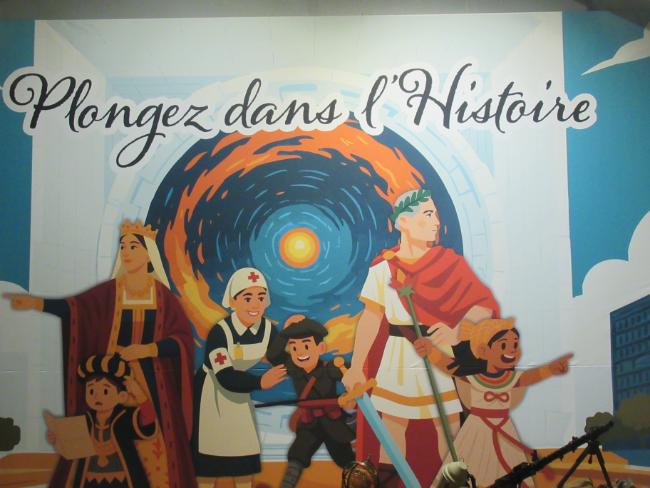
This unlikely encounter occurred in, of all places, La Défense. For at one end of the esplanade, surrounded by high-rise business blocks and endless shopping opportunities is the Cité de l’Histoire, an immersive museum where you can walk through the history of France, backwards from today to the ninth century and encounter some of the key figures in person. Well, ok, actors portraying them. I did the tour in French, but when I asked the cabinet-maker’s wife I found cowering in a workshop watching the fall of the Bastille through her window, whether they could all speak English if required, she came straight out of role and said yes, of course.
It’s an interesting way to get to grips with the story of France. It all starts more or less in the present, then winds its way back through the centuries via 17 tableaux which allow you to wander from President de Gaulle’s study just after the last war right back to the terrifying moment in 845 when 4000 Vikings sailed up the Seine and invaded Paris. A commentary explains the key events, illustrated by specially built scenes and enlivened by actors who pop up in role and dive straight into dialogue with you. You can’t help but feel immersed in l’histoire de la France in the most immediate of ways.
The opening room had photos of the Arche de la Défense, the enormous archway under which the museum nestles. In it, plucking one significant moment of history from the last century, TV coverage was playing of Edith Cresson, France’s first female prime minister, elected in 1991. This is not an exhibition which does things in exhaustive detail, but skims over time, selecting this when others might perhaps have chosen that. Next, I was taken back through a room where de Gaulle was reading his memoirs to the twin horrors of the 20th century. A reminder of the traumatisme collectif that was the German occupation of France in World War II led poignantly into the coverage of Verdun in 1916, when so many Frenchmen died in the battle which it was hoped would be the “war to end all wars.”
A classroom from 1903 was staffed by a stern-looking teacher who was keen to tell me that education in France was now “free, secular and compulsory.” I should thank Jules Ferry, she said, the Minister of Public Instruction who had revolutionized the education system in the 1880s. The political turbulence of the 19th century was highlighted through a handful of key years. First, 1870, when the Second Empire came crashing down, before that the revolution of 1848, which ended the monarchy, albeit to replace it with an empire, as I’d just been reminded. The revolution of 1830 obviously hadn’t worked out as planned, just replacing one set of royals (the Bourbons) with another rather less autocratic one (the Orléans) who, as it turned out, lasted only another 18 years.
No one emerged from the Napoleonic tableau to talk to me. I doubt he liked the English very much and the scene portrayed him deep in Russian snow with plenty else to think about. In the next tableau, the cabinet-maker’s wife who beckoned me into her workshop was fully in role despite the quite terrifying sound effects denoting the fall of the Bastille prison just across the street. Don’t go out, she said, Paris is all aflame. An Assemblée Nationale (parliament) might emerge, but until things settled down it was dangerous to be on the streets. We had a brief exchange about whether she could say all that in English – yes, she assured me, all the actors have learned their scripts in both languages – then we reverted to 1789 and exchanged hopes that it would all turn out for the best.
Cité de l’Histoire. Photo: Marian Jones
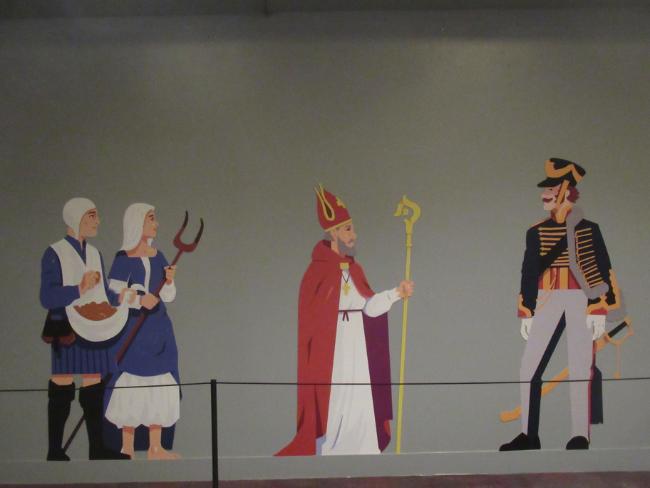
Further back in the 18th century, I got glimpses of the causes of the revolution. The court was a center of high fashion under Louis XV, but the Enlightenment was encouraging people to question the established class system. In the next tableau, Louis XIV was traveling in golden splendor to marry his mistress, Mme de Maintenon, seemingly unaware of how the 99% around him were faring. Next, came a pastoral scene from the 16th century, when, said the commentary, nine tenths of the French population lived a rural life. But, it continued, it wasn’t as idyllic as it looks. Taxes were high, bandits were rife and there was violence incessante because of the wars of religion.
After that came my encounter with Joan of Arc, who explained that the English had “wanted to recover their crown,” her expression very much encouraging me to admit that we hadn’t managed it. Nearby tableaux were dedicated to medieval culture, religious art from Albi Cathedral and glorious church music from the Capetian dynasty around the turn of the first millennium. They reminded me that history is so much more than dates, battles and kings. The last tableau brought a frantic young woman rushing towards me, yelling “crouch down, for heaven’s sake get your head out of the firing line.” The Vikings had landed, we could see their ships lined up on the distant Seine and their intentions for Paris were devastatingly simple: tout détruire, to destroy everything.
Cité de l’Histoire. Photo: Marian Jones
If you’re happy to throw yourself into the pretense, you will certainly enjoy this interactive approach to reviewing 12 centuries of French history. The target audience is families and reviews left on the site are appreciative, comments including “un excellent moment culturel en famille” and “une magnifique expérience, en immersion total.” If you want to add to this speedy run-through of French history (backwards!) then there is also a time frieze covering 200 key dates through a wall display augmented by interactive screens. Special topics are covered too and the current offering includes a 360-degree presentation which whisks you back to Caeser’s Rome and takes you through “his military campaigns, political decisions and legacy.” Previous topics have included a virtual reality tour inside Notre Dame and a chance to go exploring with Christopher Columbus or take part in the D Day landings.
This multi-sensory journey back in time is the work of the Paris-based company, Amaclio Productions whose aim is to use state-of-the-art technology to “plunge you into the heart of French history.” I enjoyed spending an hour or so topping up my knowledge, sorting one revolution from another and seeing connections between all the various periods of France’s past. And I had certainly never dreamed that I’d get the chance to converse with Joan of Arc.
DETAILS
Cité de l’Histoire
1, parvis de la Défense (underneath the Grande Arche)
Nearest metro Défense Grande Arche (Exit 1)
Open Wed-Friday 10 am – 7 pm, school holidays only
Saturday and Sunday 10 am – 7 pm
Entry €15.99, concessions €10.99, under 7s free
Lead photo credit : Cité de l’Histoire. Photo: Marian Jones
More in Cité de l’Histoire, La Defense
Related Articles


By Marian Jones