The Courtesan’s Lost Paris Apartment
- SUBSCRIBE
- ALREADY SUBSCRIBED?
BECOME A BONJOUR PARIS MEMBER
Gain full access to our collection of over 5,000 articles and bring the City of Light into your life. Just 80 USD per year.
Find out why you should become a member here.
Sign in
Fill in your credentials below.
Back in 2010, behind the door of a fourth-floor apartment at 2, Square La Bruyère, not far from the Moulin Rouge, the auctioneer Olivier Choppin de Janvry discovered a secret world that had lain undisturbed and undiscovered for 70 years. He felt he was entering the mysterious world of a demimondaine who, apart from the thick layer of dust, seemed to have just left the apartment moments before.
The 150 square-meter apartment in this pretty square had not been entered since 1940. Marthe de Florian had bought it at the end of the 19th century in the Belle Epoque era.
Its coffered ceilings and glittering chandeliers were reflected in the huge, gold carved mirrors hanging on the now rather faded and peeling wallpaper. The marble fireplace in the salon displayed Chinese vases and brass ornaments including an Arabic coffee pot. There were Persian rugs scattered on the floor, lacquered cabinets with gilt legs, balloon backed chairs, huge paintings and even a full-sized stuffed ostrich, casually decorated with a fringed scarf. The rooms were opulent with upholstered furniture, rich colors, ornate lamps and personal objects. (Amidst this Belle Epoque splendor, an original Mickey Mouse doll was an incongruous detail.) The kitchen still had its original, wood-burning stove. The bedroom boasted a four-poster bed and somewhat moth eaten curtains, and the dressing table was lined with glass perfume bottles still holding traces of her scents.
But perhaps the most stunning find in this treasure trove of late 19th-century opulence, among the many paintings still adorning the walls, was one of Marthe de Florian herself posing in a pink muslin evening dress and painted sometime between 1900 -1910 by one of her lovers, the famed artist Giovanni Boldini. His scribbled love note on a visiting card was found at the apartment.
Boldini was born in Ferrara, Italy and moved to London where he painted portraits of distinguished members of society, including the Duchess of Westminster, before moving to Paris where he became a friend of Edgar Degas. By the end of the 19th century, Boldini was the most fashionable portrait painter in Paris and his portraits commanded high prices. He painted all the “grande dames” and at the time, Boldini’s works were considered racy; his décolleté paintings, the extreme limits of convention. (A full-length painting of Marthe de Florian in the same clothing but slightly more circumspect, hangs in the New Orleans Museum of Art.)
The auction of the contents of 2, Square La Bruyère was held on September 28th, 2010 at the Hotel Drouot in Paris.
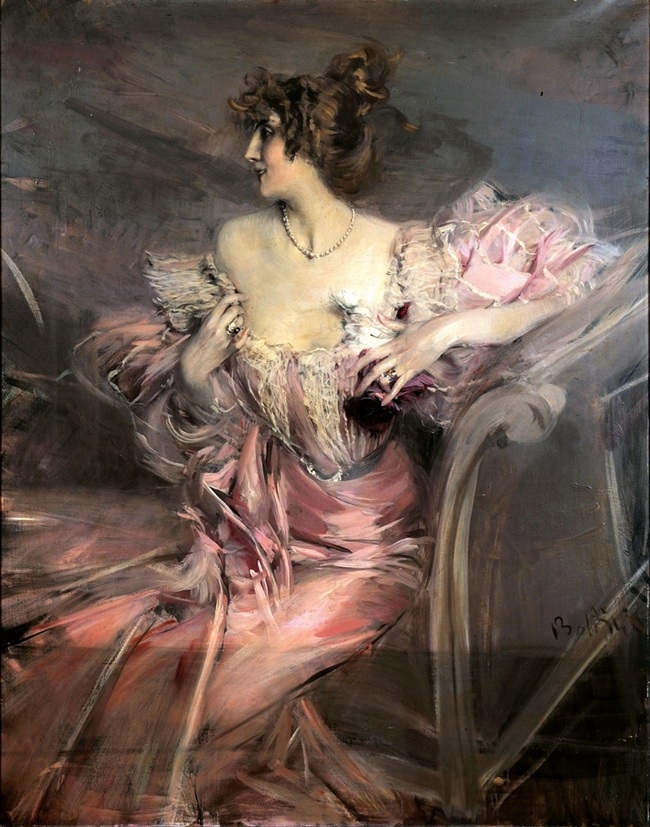
Portrait of the actress Marthe de Florian by Giovanni Boldini. Public Domain
The auctioneers had estimated the auction price of Boldini’s painting at 300,000 euros. Ten bidders thought otherwise and the sale price soared to more than 2 million euros — a record for Boldini’s work. It was perhaps the unexpected sale price of this otherwise unknown painting that sparked the imagination of the newspapers and the public to this abandoned apartment.
And so, who was this mysterious Marthe de Florian? Her rags-to-riches story was not wildly uncommon for certain women of this era: the demimondaines, courtesans, who — with beauty combined with astuteness, if not blessed with a fine education — climbed their way out of poverty to become rich mistresses of powerful, wealthy men.
Marthe de Florian was no exception.
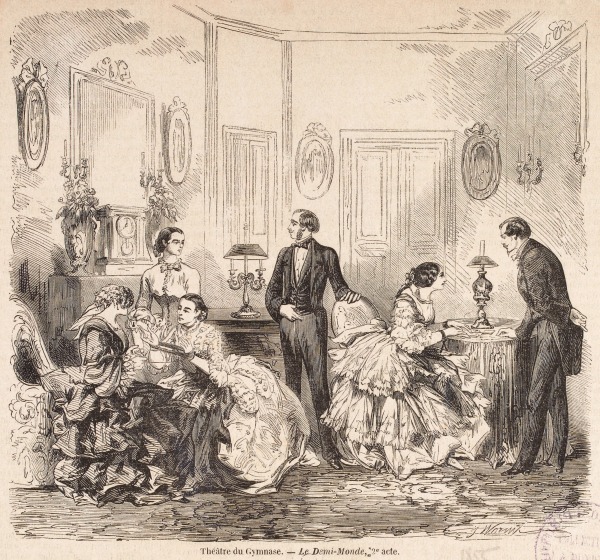
Le Demi-Monde, Comédie d’Alexandre Dumas, Théâtre du Gymnase à Paris, 1855. Image: BnF
She was born Héloïse Mathilde Beaugiron on September 9th, 1864 in the 18th arrondissement of Paris, to Jean Beaugiron and Henrietta Eloise Bara. At the age of 18, she gave birth to a son, Henri, father unknown. On his death certificate three months later, her employment was recorded as an embroiderer. A year later, at 100, Rue St Lazare, she gave birth once more to another son she also named Henri. (It is possible the baby’s father was the married banker Auguste Albert Gaston Florian Mollard, who was certainly one of her lovers, and it is possible she took her name from him.) It is known that Marthe married a merchant giving her access to the bourgeoisie, although little is known of their marriage. Her career as a courtesan must have flourished soon after the birth of the second Henri in 1885, for her to have acquired and furnished the apartment in Square La Bruyère, where Henri lived with her until her death in 1939.
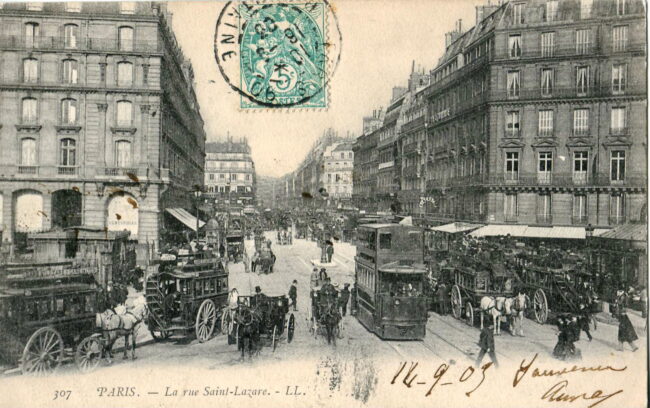
Vintage postcard of the rue Saint-Lazare. Public domain
Beauty, wit and bedroom skills were a commodity that paid well for a courtesan in that era, and Marthe de Florian was blessed with all these attributes. She was described in a contemporary periodical as a “blonde, frivolous woman with chubby and pink flesh like cherry blossoms,” and “a baby face lit up by two pretty eyes.”
She certainly charmed many of the most famous names of that time. Her list of lovers included French prime ministers and presidents of the Third Republic including Georges Clemenceau, Raymond Poincaré and Paul Deschanel, along with numerous wealthy businessmen and artists. Letters, tied with different colored ribbons denoting each lover, were found in a drawer and it is believed that some were offered to the successful Italian bidder of the Boldini portrait.
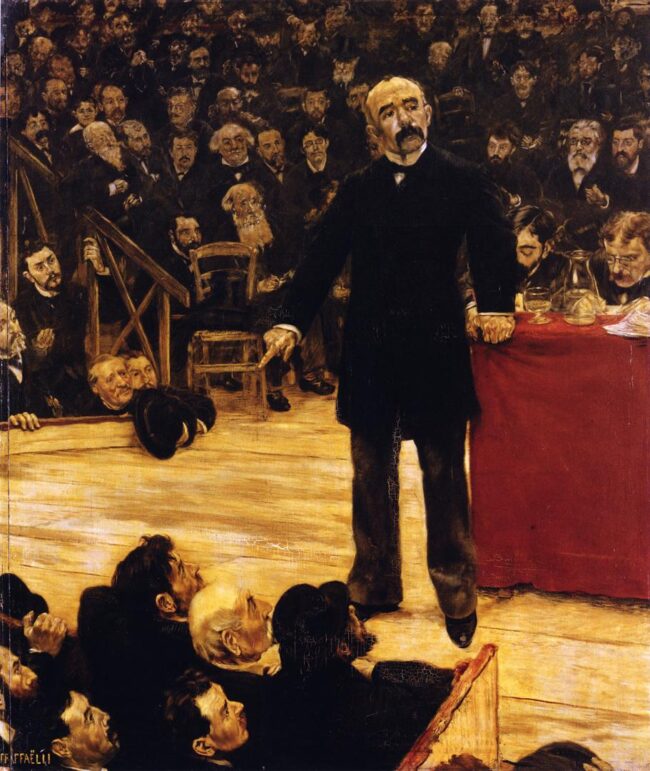
Clemenceau giving a speech in the Parisian Fernando Circus, painting by Jean-François Raffaëlli, 1883. Public domain
It is in 1939, when Marthe de Florian dies, that the real mystery begins. Henri Beaugiron signed his mother’s death record at the apartment in Square La Bruyère where he was living at the time. However, Marthe de Florian actually died in Trouville-sur Mer, and not in Paris, and death certificates must be registered where the person died. This is the first of several anomalies in the history of Marthe de Florian. In 1940, just after the death of her grandmother, Solange Beaugiron, Henri’s daughter, fled Paris to escape the Nazis and settled in the Ardèche. (Again, some reports state that Solange fled in 1942, but this is highly unlikely as France was under German occupation, curfews were extremely strict and escape would have been incredibly difficult.)
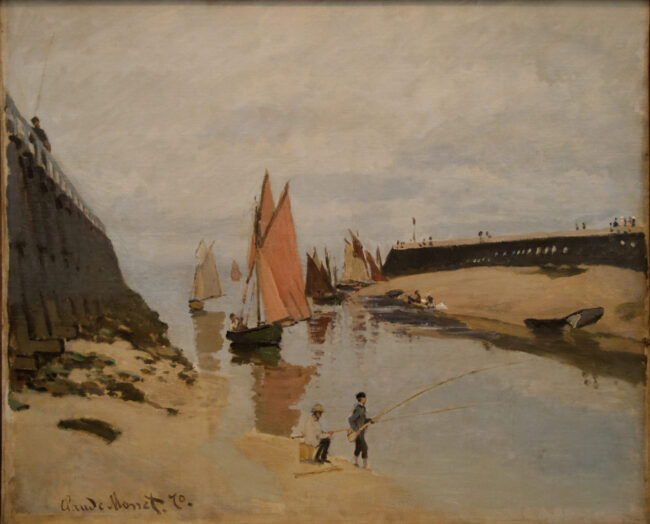
Claude Monet, Le Port de Trouville (1870), Musée des beaux-arts de Budapest.
Henri died on May 12th, 1966. According to death records, Henri died in the apartment at 2, Square La Bruyère which would cast doubt on the claim that the apartment had been left empty for 70 years. There is no record of whether any of Henri’s belongings were found in the apartment, and it is clear from photographs that the furnishings had not been touched. Marc Ottavi, the art expert who was there when the apartment was opened in 2010, stated that there were papers dating back to late 1955.
But of course, the biggest mystery of all was that of Solange Beaugiron who inherited the apartment in 1966 on the death of her father. Why did she never return to Paris? Not even for her father’s funeral? Why did she continue to pay all the bills on an expensive apartment and never once return to clear it or sell it? Her death has ensured that those questions remain unanswered.
Solange Beaugiron died at the age of 91. (She wrote plays and novels under the pseudonym Solange Beldo or Solange Bellegarde.) She had no children to inherit the amazing lost apartment in 2, Square La Bruyère, and its secrets and love letters remain sealed away indefinitely.
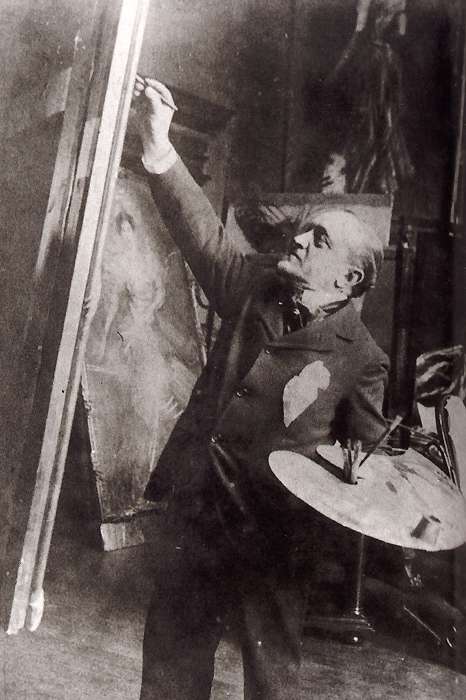
Photograph of Boldini in his atelier, by Alice Guérin, c. 1925. Public domain
Footnote: Although art experts date the Boldini painting between 1900-1910, Marthe was said to be 24 years old when the painting was completed. She was born in 1864, which would make the painting date to 1888, a date Boldini inscribed on a love note to de Florian.
A good mystery always leaves questions unanswered and tantalizing loose ends that only the sealed apartment at 2, Square La Bruyère still holds within its walls.
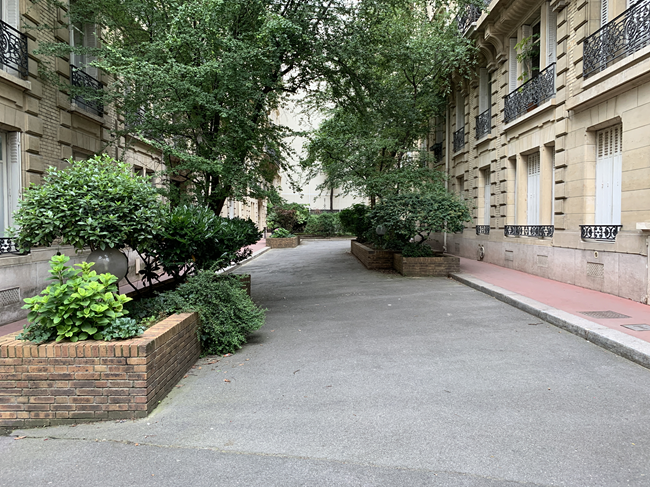
Lead photo credit : Square La Bruyère. Photo: Chabe01 / Wikimedia commons
More in belle epoque, courtesan, demimondaine, Marthe de Florian
Related Articles