Colorful Inspiration at the Quai Branly’s Africa Fashion Exhibit
- SUBSCRIBE
- ALREADY SUBSCRIBED?
BECOME A BONJOUR PARIS MEMBER
Gain full access to our collection of over 5,000 articles and bring the City of Light into your life. Just 80 USD per year.
Find out why you should become a member here.
Sign in
Fill in your credentials below.
From fabric color and feel to style and silhouette, African fashion has influenced the fashion world for years. African stars, models, clothes and designers stood out at the US Met Gala. The upcoming Africa Fashion Week London will showcase African and African-inspired style. And the Africa Fashion exhibit at Musée du Quai Branly tells the story of fashion from Africa, and its global influence. The exhibit is full of fashion and fabrics that animate and educate. It also inspired me to explore African fabric stores in Paris to see the colors, designs and textures of the fabrics up close.
African fabrics and fashion are part of the continent’s history, and Africa Fashion starts with African nations regaining their independence from colonial governments in the 1950s and 1960s. The pride of being African influenced many daring fashion designers to build brands, including Alphadi, Sade Thomas Fahm and others. Their style focused on blending traditional fabrics and crafts with stylistic innovations resulting in colorful new definitions of fashion from a myriad of African perspectives. The exhibit then takes the viewer to current times along the path of creative use of textiles and style.
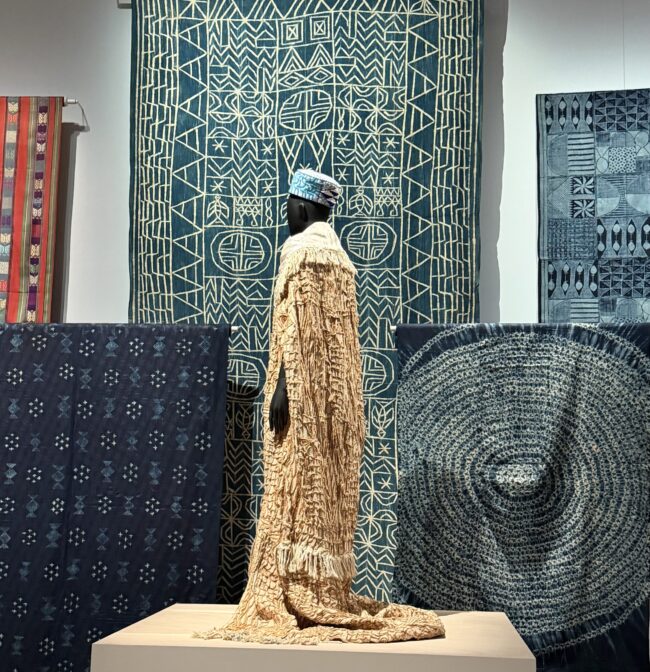
Kente and indigo fabrics compared to a textured design at Africa Fashion exhibit. Photo: Martha Sessums
Alongside the African fashions are selections from the Musée du Quai Branley’s collection of heritage African textiles, accessories, jewelry and photographs. This combination offers a dialogue between past and present which illustrates the historical influence on today’s styles.
One of the key parts of African fashion is the different textiles and printed fabrics found throughout the continent. There are approximately 25 different African prints and fabrics, but it all started in ancient Egypt with flax to weave linen. The Dutch and French influenced the industry in the 1800s with dyes such as indigo, and other colors and ways to weave material. The wax style was originally developed in Indonesia but was quickly adopted by Africans. Much of the international African fabric production industry was and still is in Holland (and other countries) but the patterns have a respected African vibe. Post-independence, Africa reinvigorated its textile manufacturing industry and with technology currently improving textile production, the industry in Africa is growing. From fashion to interiors, African fabrics are setting global trends.
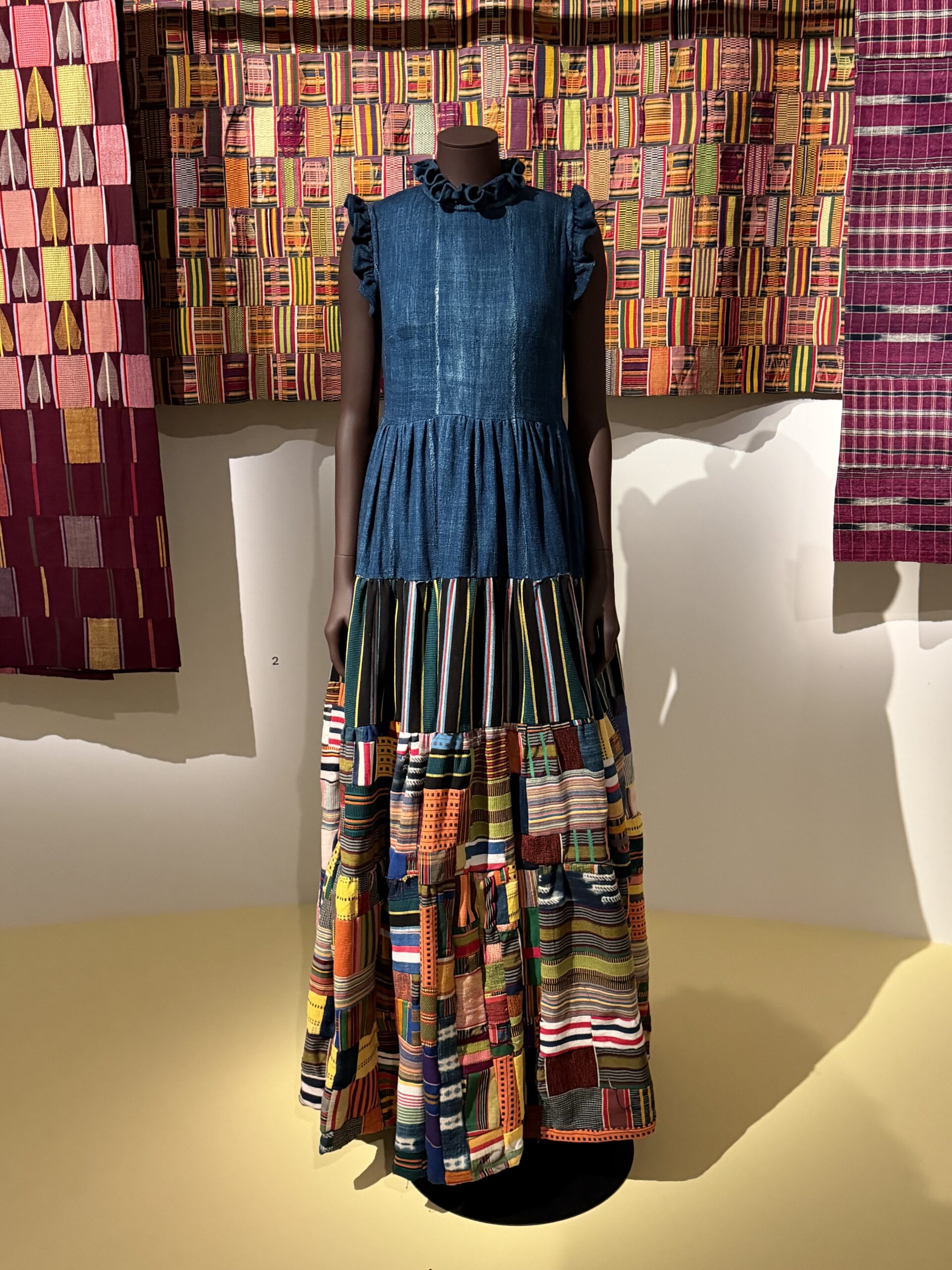
Indigo and Kente dress at Africa Fashion exhibit. Photo: Martha Sessums
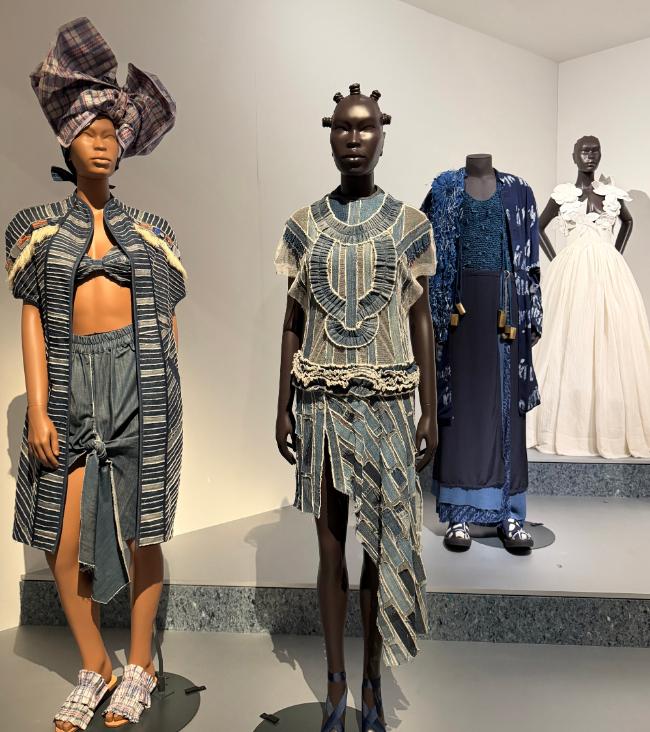
The exhibit showcases African fabrics such as Kente (one of the most prestigious and famous, its colorful stripes create complex patterns), wax (waxed cotton makes the colors shimmer), Bogolan (patterned fabric using mud as the dye), and Ndop (woven cotton died with indigo and white designs). Fabrics are prized for their beauty, quality, African symbolism and even political meanings. Then there are the dyes used, including indigo which is the blue seen throughout the world but contemporarily known in denim fabrics. Indigo has been used throughout West Africa for centuries and is used as a solid or part of a pattern.
Many examples of the different African fabrics are hung in the exhibit to help give background to how they are used in fashion. One dress has an indigo top with a skirt of Kente stripes and in the background are hung pieces of Kente. Other outfits use the colorful fabrics in new ways such as shoes, suits and an evening dress with a gold breast plate. Elegant colorful wax fabrics create loose, flowing dresses. There are Bogolan tops with raffia skirts, and a men’s black suit with gold lion faces stitched on the jacket.
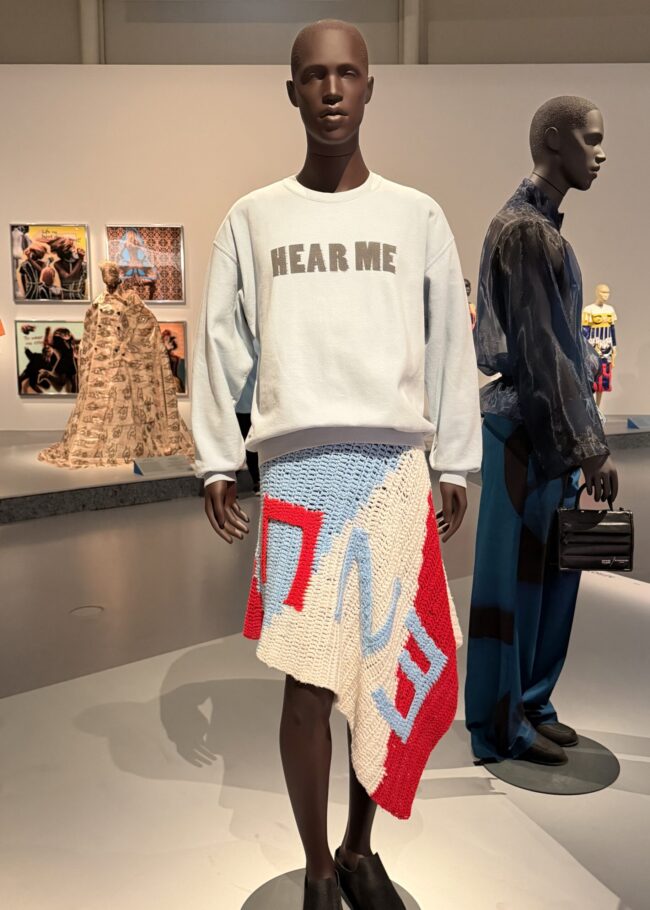
Sweatshirt with woven skirt at Africa Fashion exhibit. Photo: Martha Sessums
In a video featuring Nigerian designer Alphadi, he says, “African haute couture has always existed in textiles including beading, embroidery and weaving. For many years, Europe and America have been inspired by our continent … and many great designers have been inspired by our African craftsmanship… Of course, we too are inspired by our craftsmanship, values and textiles. When I create a collection I think about textiles, I think about shapes, and I think about where I am… It’s a way of rubbing shoulders with other cultures that gives one an international perspective.”
Current designers and their fashions are the last part of the exhibit. The fashions mix patterns, textures, cuts and prints to create a new cultural language that has references of the past while appealing to the future. A sweatshirt is combined with a woven skirt. An off-the-shoulder dress flows widely with wax lace borders. Multiple different designs and silhouettes are combined to make a dress dramatic. A flowing fuchsia pink fringed raffia top with pink silk pants makes volume which creates presence. Starting with the first African designers from the 1960 to the popularity of current designers, the story of African fashion is told in fabrics and style.
The exhibit inspires the desire to find African fabric (tissue) stores in Paris and be able to touch the fabrics and closely see the textures and designs. I researched some African fabric stores in the 18th arrondissement and invited a friend, Susan, who works with a non-profit in Cameroon, to accompany me.
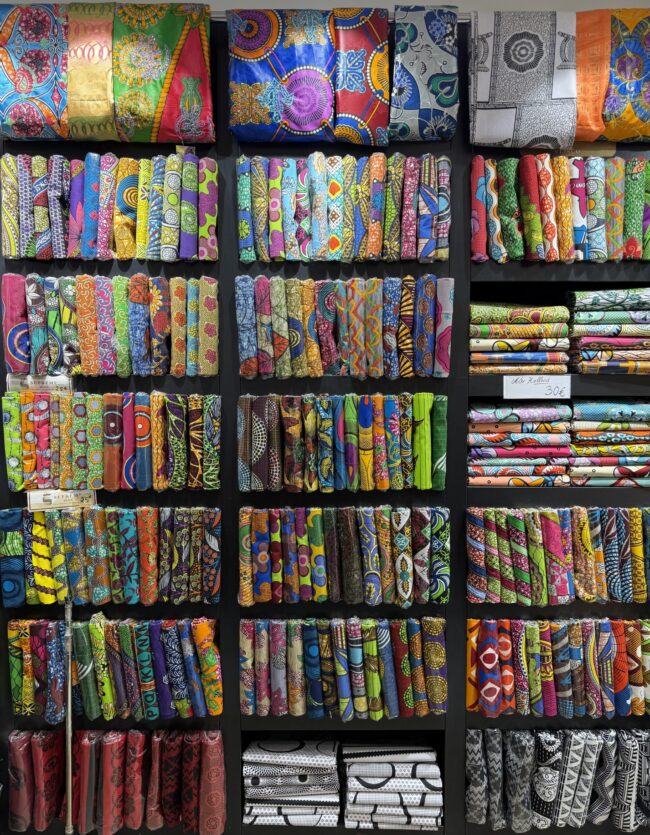
Wall of fabric at Holland Textiles. Photo: Martha Sessums
First stop was a group of three stores selling African fabrics at 68 rue Doudeauville. The first one we entered was Holland Textiles and were met with walls filled with fabric coupons (precut fabric) folded in 6-yard lengths that make a colorful greeting. There were many types of fabrics from color-laden Kente to elegant wax to black and white Bogolan. The fabrics were from Mitex Holland, a well-known brand in the African fashion and fabrics arena. The prices varied from 25 euros a coupon to 249 euros for “grand super wax” coupon from the Vlisco brand. Vlisco has been creating African fabrics since 1846 using the wax-based batik technique. The designs are created by an international team but it’s African women who gave the names, meanings and cultural significance across West and Central Africa.
The store owner was very friendly and willing to show off any fabric that interested us. He explained the brands were well respected throughout Africa and the world and used by designers and home seamstresses. He said his store was mid-range fabrics while the other stores were top range and lower range and all were excellent quality fabrics.
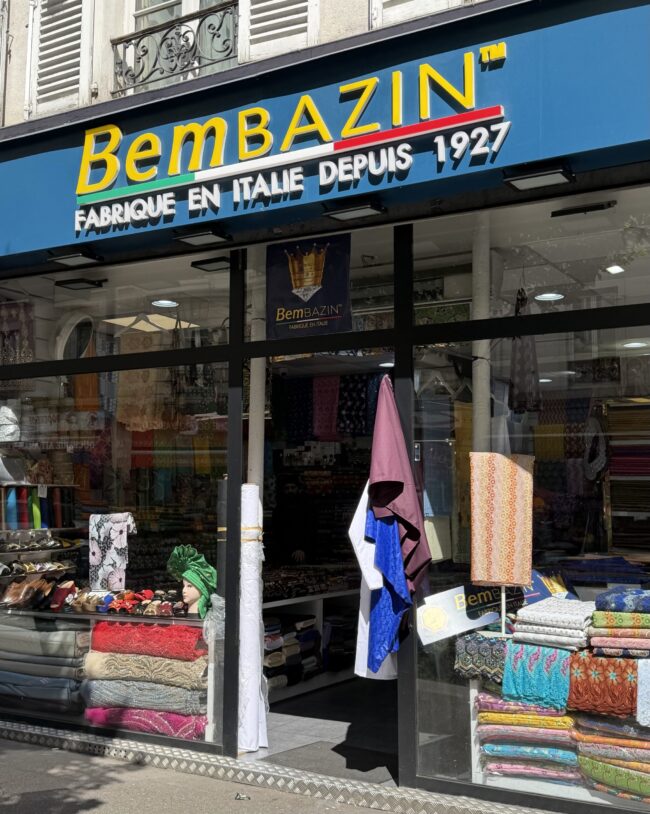
Bembazin storefront. Photo: Martha Sessums
We stepped into Bembazin at 70 rue Doudeauville, the high range store, and were greeted by spools of gold, pearl and colorful lace. There were coupons of beautiful wax solid colors and with elegant textures which Susan said were preferred in Cameroon. Lots of silk and beaded fabrics lined the shelves with edges that were full of curves and unique designs. The fabrics are made in Italy and are of high quality, appealing to designers who pick a fabric and then design a dress with a grand silhouette.
The third shop, African Textiles, was full of colorful and fun fabrics, including one of growling lions with red tongues. Fabric coupons started at 15 euros and went up to 25 euros and there were lots of bags, pillowcases, coin bags and African hats to choose from. There were also slim bracelets covered in Kente fabric and I bought five of them. On-site tailors are available to create custom clothes for men and women.
Our last stop was Wax Jolie Afrique at 30 rue Poulet. The windows were covered with folded coupons in a variety of colors and designs, and the step inside was also a colorful greeting. Many of the fabrics used Egyptian cotton and the brands were from Africa and Holland. The variety included colorful Kent designs, elegant lace and Bogolan in brown, cream and black. Susan fell in love with a yellow, orange, red, purple and black Kente and bought the coupon for 25 euros.
The experience of learning about African textiles and design from both the Africa Fashion exhibit and the visit to African tissue stores was, as Alphadi said, “A way of rubbing shoulders with other cultures that gives one an international perspective.”
And what a vibrant, colorful, textural perspective to enjoy.
Africa Fashion is at the Musée du Quai Branly until July 12, 2026.
Lead photo credit : Modern fashion using indigo fabric at the Quai Branly exhibit. Photo: Martha Sessums
More in Africa, Africa in Paris, Musée du Quai Branly
Related Articles