‘My Name is Orson Welles’ at the Cinémathèque Française
French cinéphiles, film scholars and filmmakers have always had a soft spot for Orson Welles (just as he loved France, especially its food and drink). When he died, the newspaper Libération called him “the giant”. He lived in Saint-Paul de Vence for a time, a film of his was commissioned by French TV, and the great actress Jeanne Moreau made indelible appearances in The Trial and The Immortal Story. Now the French Cinémathèque is offering an exhibit on his life and career: My Name Is Orson Welles (it runs until January 11). You have to give the Cinémathèque credit: they try to do justice to Orson Welles’ many-sided persona and career while putting him in historical context. The effort is thrilling, and many will learn an enormous lot about the director of Citizen Kane.
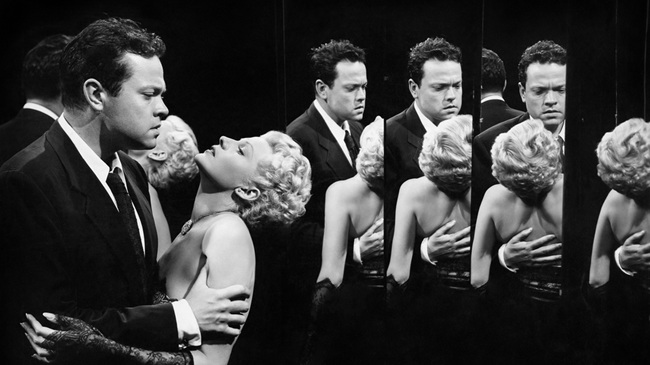
The exhibit has assembled a dizzying array of still photos, film extracts, audio clips, copies of archival materials and even replicas of radiophones and movie cameras. They’ve also concocted amusing installations (one to do with the famous mirror scene in Lady From Shanghai). Welles remains best known for Citizen Kane, the story of a newspaper magnate based on William Randolph Hearst. We can see letters concerning the legal threats made by Hearst to stop the showing of the movie. But we also learn about connections between Welles’ own life and Kane, for example the fact that his childhood guardian, like a similar character in the film, was named Bernstein. I was startled by how autobiographical the film was, albeit in an oblique way (no word on whether he had a sled named Rosebud). Of course, many will also see parallels to Kane in contemporary political figures, media barons and tech oligarchs.
On the political side we learn about Welles’ progressive activism, his contributions to the FDR administration and the war effort. Some of this had been forgotten. But even his early career owes a debt to the Roosevelt Administration. He first made his mark in the theater, staging a modern-dress version of Julius Caesar and an all-black production of Macbeth (set in Haiti). Most of these were funded by the New Deal WPA (Work Projects Administration). Welles later became an editorial commentator on the issues of the day, and during the war met dignitaries in Washington (he said the greatest man he’d ever met was General George Marshall).
He staged the theater plays while still in his early 20s. Even younger, while little more than a boy, he sojourned in Ireland and acted in dramatic productions in that country. Photos from that period show Welles’ love of make-up and self-transformation, which continued throughout his life. He created a troupe called the Mercury Players, and took them with him to radio and then to the movies.
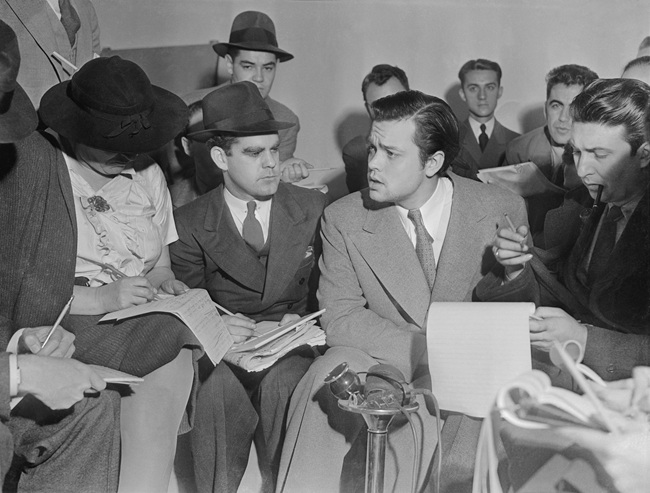
Welles at the press conference after “The War of the Worlds” broadcast (October 31, 1938). Credit: Wikimedia Commons
Some may remember that Welles caused a sensation with his radio production of H.G. Wells’ War of the Worlds. He put on the radio play as if it was a news broadcast and thousands panicked, believing that we were under Martian attack. This was a prescient premonition of the power of fake news, and media in general. In terms of sci-fi, his portrayal of the invaders’ “walking machines” influenced George Lucas’ The Empire Strikes Back and the retrospective absurdity of the stunt surely influenced Tim Burton’s Mars Attacks. We can also peruse letters from irate officials who wanted to have Welles fired, or worse.
Beyond the phenomenon of War of the Worlds, Welles spent a whole phase of his career in radio. There were other radio plays (adaptations of Dracula, Heart of Darkness), and he played the mysterious crime fighter in The Shadow. (My father, who listened faithfully to the show on the family console as a child, could recite the ominous intro decades later: “Who knows what evil lurks in the hearts of men … the Shadow knows.”)
The exhibit also surveys Welles’ obsession with William Shakespeare. He identified with Shakespeare from an early age, and the idea of life as a stage and identity being a collection of roles was part and parcel of his own vision. He acted in the Bard’s plays, staged them, and adapted several to the cinema: Macbeth, Othello, and Chimes at Midnight (featuring Shakespeare’s tragicomic clown Falstaff from several works).
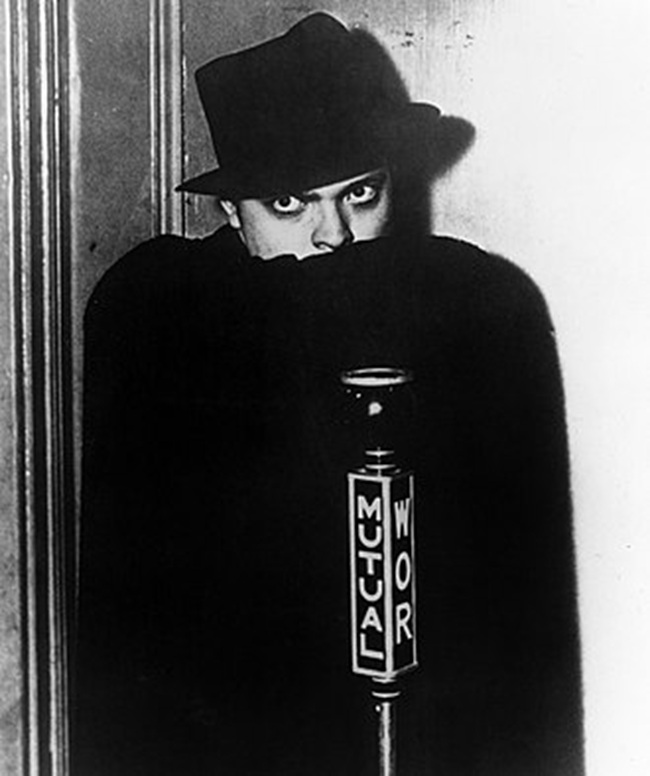
Welles was the voice of The Shadow on the Mutual radio network (1937–1938). Credit: Wikimedia Commons
Apart from Kane, the exhibit examines other Welles masterpieces, such as the Magnificent Ambersons and Lady from Shanghai, looking not only at their genius but the difficulties he had in making them. Then there are the legendary aborted projects that never saw the light of day, including a planned film adaptation of Heart of Darkness (which he’d brought off for radio). We get glimpses of a number of films, like The Other Side of the Wind, Don Quixote and It’s All True that were never completed or released during Welles’ lifetime, though versions have been screened at the Cinémathèque and other venues.
The exhibit even includes snippets from the more trivial side of Welles’ life and career: the appearances on TV shows and commercials. Who can forget “We shall sell no wine before it’s time”? (Well, anyone too young to have been in front of a television then.) Orson Welles was also a magician at one time. In fact, a case can be made that he was always a magician. The Cinémathèque exhibit, curated by Frédéric Bonnaud, brings us backstage in a sense, and reveals some of the trickcraft, without extinguishing an abiding sense of the man’s mystery.
DETAILS
Until January 11, 2026
La Cinémathèque Française
51 Rue de Bercy, 12th
Tel: +33 (0)1 71 19 33 33
Closed Tuesdays
Full-price ticket: 14 euros
Please note: the Cinémathèque screening rooms will be closed from November 28, 2025 to January 2, 2026 to treat the seat upholstery against bedbugs. This does not affect the exhibits.
Lead photo credit : Orson Welles at the Cinémathèque française
More in Orson Welles
Related Articles