Just an Illusion: From the Hit Filmmakers Behind ‘Intouchables’
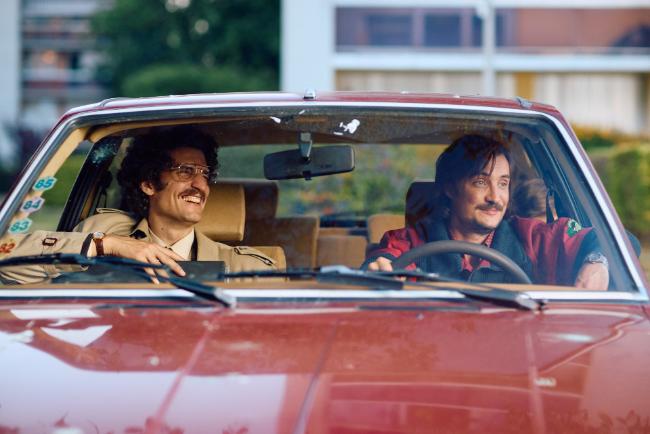
Over the years, filmmakers Eric Toledano and Olivier Nakache have forged a remarkable career. Not because their films are so brilliant. Rather, they’ve worked together as a symbiotic team born of youthful friendship. They collaborate on both writing and directing. (Even the Coen Brothers had a separation of labor, and they’re brothers.) They are French Sephardic Jews who like many performers from that community, have mined its earthy, warm culture for comedic success, just as Jewish comics in America did. TV variety shows were their Catskills, but Toledano and Nakache have not only transitioned to directing successful comedies in their mainstream style, but made one of the most successful French films ever, Intouchables. That film was about the hilarious relationship between two unlike characters, a very French paraplegic and a black-from-the-hood caregiver. With Juste Une Illusion the directors return to their own roots in the Paris banlieue, circa 1985.
Juste Une Illusion is about a boy, Vincent (Simon Boublil), on the eve of his Bar Mitzvah, when according to the tradition he will become a man. In a way the film resembles American Graffiti, where a group of teens have a last gasp of youthful hijinks before embarking on (yuck) adult life. Vincent lives in a Brutalist housing project in a Parisian suburb with his parents and older brother. The apartment is cramped, leading to comic collisions that culminate in operatic yelling followed by sentimental reconciliation. Vincent also has his multicultural band of buddies with whom he has several misadventures. One has to do with their frenetic efforts to retrieve a chess set his parents lent to their rabbi. (Not so funny? I forgot to mention the chess set is where Vincent had stashed a porno VHS.)
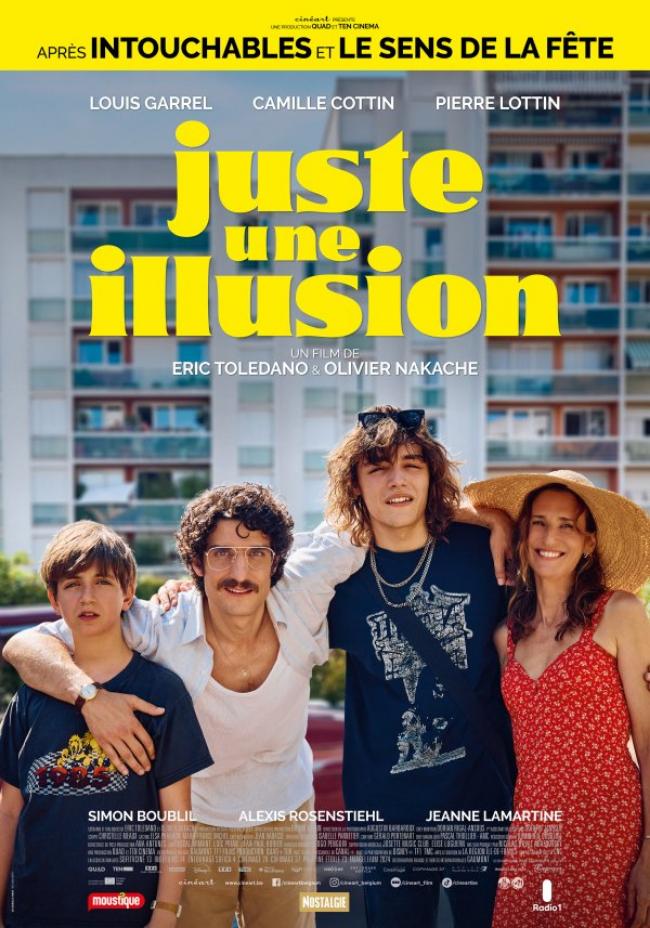
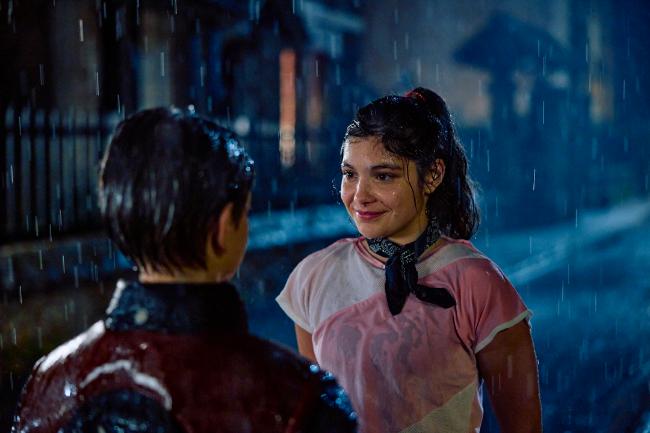
Vincent has a crush on a girl classmate, Anne-Karine (Jeanne Lamartine), who also lives in the suburb but whose parents are stuffy, the father a racist right-winger. This adds sweet narrative interest, but feels clichéd. Given their age, the relationship sits uneasily between puppy and physical love. That said, Ms. Lamartine is a real natural, and gives the most affecting performance of the film, even at the risk of upstaging Boublil.
Juste Une Illusion is also about family. The directors poignantly depict the stresses of the parents: Sandrine (Camille Cottin) is on the verge of moving from secretary to executive by mastering the new computer technology, but seems unable to deal with the loss of control over her family. Yves (Louis Garrel) is unemployed (in the 1980s French unemployment shot up to 10%). While he experiences some unexpected luck in this feel-good movie, he doesn’t actually land a job. (His old job was at Moulinex, a maker of kitchen appliances that dominated the market, but progressively lost its “champion” position).
Still from “Juste une illusion.” Credit: Manuel Moutier/ ADNP/ Gaumont/ TF1 Films
Arnaud, the older brother, the cool one, loves music and escaping the household through the window late at night. He’s just getting by in school, but is making oodles of coin by selling music-compilation cassettes (if we believe him), and even lends money to his father. Arnaud is charismatically played by Alexis Rosenstiehl, but the character leaves us uneasy. If you’ve been around awhile you know that this kind of person might very well succeed, probably as a glib sell-out, or else become a feckless loser, or worse.

Still from “Juste une illusion.” Credit: Manuel Moutier/ ADNP/ Gaumont/ TF1 Films
Toledano and Nakache do a serviceable job directing, but not much more than that. In their years making films they haven’t evolved into French equivalents of Woody Allen. As comic directors, they’re at least not too proud for broad effects which keep the audience laughing, or at least tittering. The directors do bring out their cast with assurance, especially the young actors, who are never cloying (though they sometimes come close). Camille Cottin has already proved herself an effective actress in TV’s Call My Agent, and is entirely believable in a role that’s more complex than appears at first. Louis Garrel, one of France’s preeminent actors (The Innocents, An Officer and a Spy), has great presence and knows how to push all the acting buttons. Yet his Yves is a bit spoiled by being made up with big hair, moustache, and glasses to look like an unholy amalgam of Groucho and Zeppo Marx. (If only he’d had a cigar!)

Still from “Juste une illusion.” Credit: Manuel Moutier/ ADNP/ Gaumont/ TF1 Films
The movie is also about a community, a time and a place. The Sephardim were relatively recent in France, arriving from North Africa mostly in the 1960s. When the countries of the Maghreb gained independence, their Jewish communities came under intense pressure to leave. They were working class or petit-bourgeois, and their beginnings in France weren’t easy, but hard work and the industrialization of the ’60s and ’70s led to prosperity. The housing projects where they lived seemed like Brutalist utopias, and credit must be given to the directors for bringing out their human aspect (even if they actually grew up in the plusher Western suburbs).

Still from “Juste une illusion.” Credit: Manuel Moutier/ ADNP/ Gaumont/ TF1 Films
The 1980s were a cusp for French society in general. The economy had reached a certain peak, but was turning. Many jobs and industries were being displaced, while opportunities opened for others. France became more multicultural, which also resulted in the rise of racism. Many families would leave suburbs now considered “gritty”, moving to more comfortable areas, but losing a sense of community. There was a special cultural moment as well, especially in rock music. 1980s rock is having a burst of retro popularity (please include me out on that), but at the time bands like Indochine, Telephone, Les Rita Mitsouko succeeded in capturing the pulse of French youth. Just An Illusion is taken from the title of a pop song. As memories fade, and even historians who weren’t there are sometimes “off” despite their research, the past may seem illusory. Some have pointed out that details in the film are not completely accurate. (e.g. Had a particular Microsoft OS really come out then?) But that just contributes to the sense of a wispy illusion, in this case a moving one.
Production: Quad Productions/Ten Cinéma/TF1 Films Production/Gaumont
Distribution: Gaumont
Lead photo credit : Still from "Juste une illusion." Credit: Manuel Moutier/ ADNP/ Gaumont/ TF1 Films
Related Articles