À Pied d’Oeuvre (‘At Work’) Reflects on the Gig Economy
- SUBSCRIBE
- ALREADY SUBSCRIBED?
BECOME A BONJOUR PARIS MEMBER
Gain full access to our collection of over 5,000 articles and bring the City of Light into your life. Just 80 USD per year.
Find out why you should become a member here.
Sign in
Fill in your credentials below.
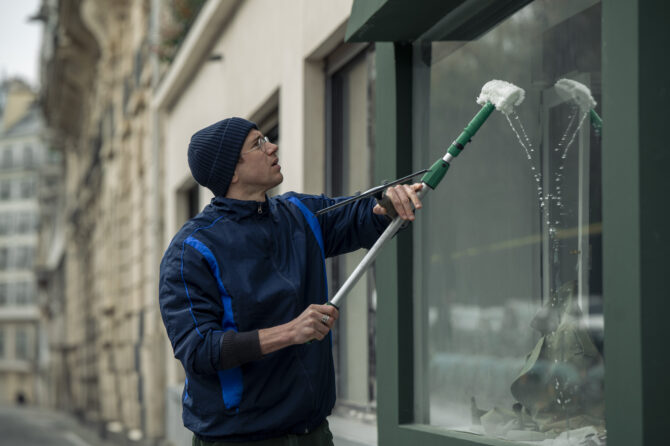
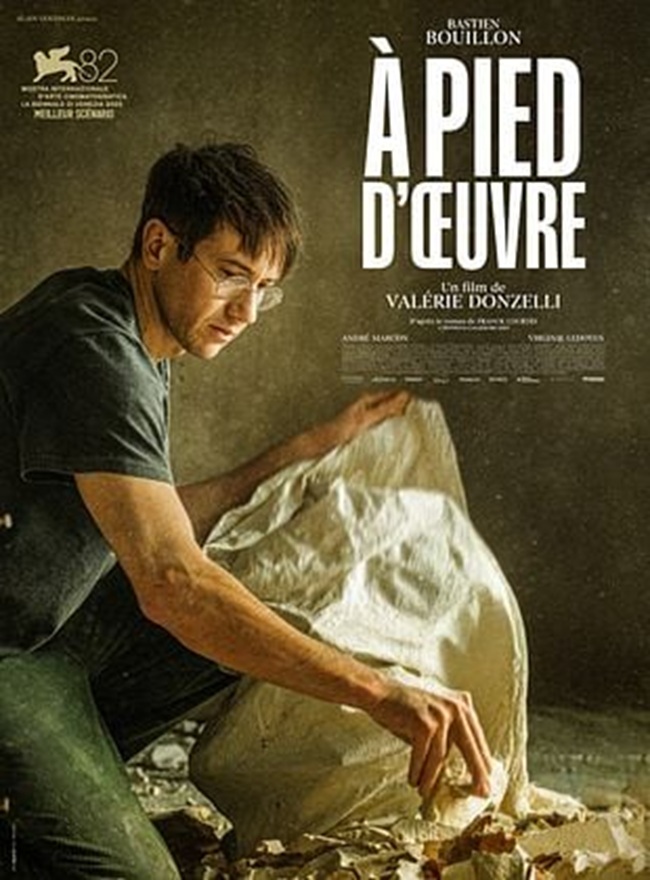
A pied d’oeuvre literally means “at the foot of work”, but translates more correctly as “ready for work” or simply “at work”. (The expression has its origins in the idea of laborers setting up their day’s activity at the foot of a wall or building.) It makes a curious title for a curious movie directed by Valérie Donzelli, known mostly as an actress. Starring Bastien Bouillon (La Nuit du 12, for which he won a César award), it tells the story of a novelist, Paul, whose latest — after four books considered “promising” — instead of being a breakout is a dud. He’d been given an advance, but now faces the probability that it won’t be published at all. The professional woes are compounded by his wife (played by Ms. Donzelli herself) leaving him. (She seems to be a disgruntled breadwinner.)
Paul is nothing if not intrepid. He keeps writing, even after the failure of his novel. With no money (or monied wife) he joins an online platform which matches desperate people with gig work of a low-paid, menial variety. The would-be worker offers a rate, but if it’s too high others will get the job. So begins a series of misadventures with various work experiences.
À Pied d’Oeuvre
As a satire of the gig economy and online platforms from Uber to Deliveroo to many, many others, the film is scarifyingly on target. It’s uncomfortable watching poor (in every sense) Paul, as we all use one service or another, off- or online. We pay domestic workers under the table, hoping they don’t fall within the cracks of social protection, and use gig workers who are technically freelance, freeing all concerned from the constraints of the minimum wage.
Bouillon is a low-key actor, but he makes his stoic character, who might have been just impassive (if not passive), interesting and moving. Paul suffers, physically and mentally, as he perseveres, and shows it. Eventually he comes to the realization that he’s become poor. Bouillon works meticulously as an actor, and it’s an understated joy to watch his performance even as his character struggles with the gig world.
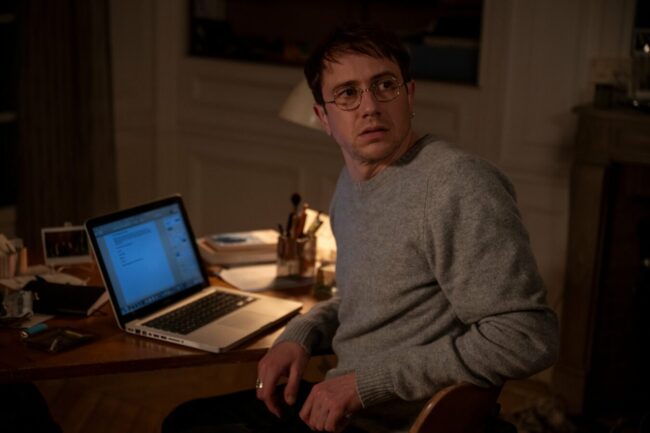
À Pied d’Oeuvre by Valérie Donzelli. Photo credit: DIAPHANA DISTRIBUTION
His parents and sister take issue with his claiming the “poor” label. “You have a choice,” says his sister. Paul answers that maintaining his artistic integrity validates his poverty. We’re supposed to agree with him. Frankly, I’m with the others. I’ve had my ups and downs, but was always aware of my relative good fortune and of the choices that I took. The definition of “poor” is a fraught subject. Moreover, France is the welfare state par excellence, and so Paul would normally have access to various types of aid.
It’s never suggested that he might go live with his parents. Nowadays this is the recourse of many who are down and out: moving back in with the folks, depending on family as a safety net. Perhaps he’s too proud. Likewise, he takes on gigs to have “time to write” (in his case, mornings). Yet Paris is full of aspiring and even published writers who find time to write despite doing some sort of day (or evening) activity, without falling into dire penury.
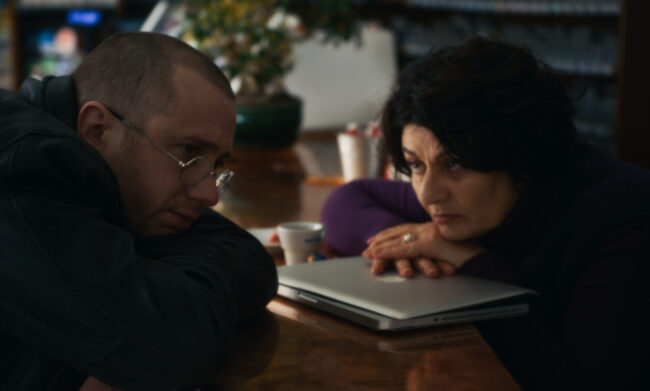
À Pied d’Oeuvre by Valérie Donzelli. Photo credit: DIAPHANA DISTRIBUTION
Paul begins to seem mulishly perverse (or perversely mulish). Especially as he has another professional arrow in his quiver: Before becoming a writer he was a photographer who made good money. He’d stopped to write novels. Why doesn’t he go back to photography work, at least part-time? We never find out what kind of photography he did, if there was something there that destabilized him. Surprisingly, this mysterious, maddening (and possibly mad) side to the protagonist actually grows on us, even as it aggravates.
The biggest irony of the film is that its main themes — grinding precariousness and literary endeavor — don’t work as well as they might. On the writing side, Paul’s filling of notebooks and the occasional artsy voice-over aren’t exactly enthralling. We don’t get much of a sense of how his experience is affecting his writing sensibility.
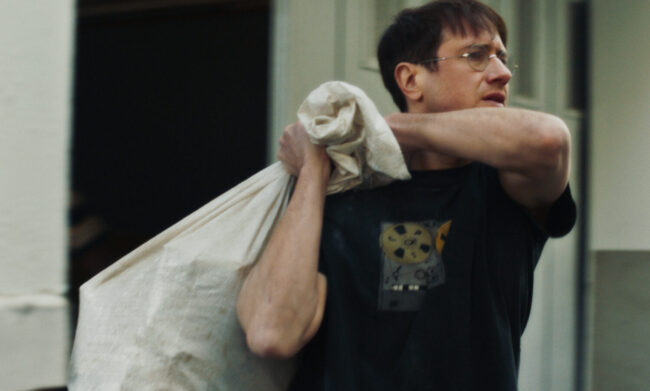
À Pied d’Oeuvre by Valérie Donzelli. Photo credit: DIAPHANA DISTRIBUTION
But the film offers other pleasures. The sheer physicality of the gig labor may be painful, but gives a sense of work as part of organic, material life. Paul does get some basic satisfaction out of it. Even interactions with employer-clients have a material realness, based on money but also their vicarious involvement in the activity (think of how we look on attentively at the plumber doing his thing in our homes).
If Bouillon’s performance is a piece of craft that’s fascinating to behold, so is Ms. Donzelli’s direction. It’s not perfect (sometimes her close-ups get too close), but her camera is usually controlled yet empathetic. Often the director (and her cinematographer) resorts to saturated color reminiscent of 16mm or even Super 8. It can be “gorgeous”, as some might say, but mainly emphasizes the organic aspect of what’s being filmed.
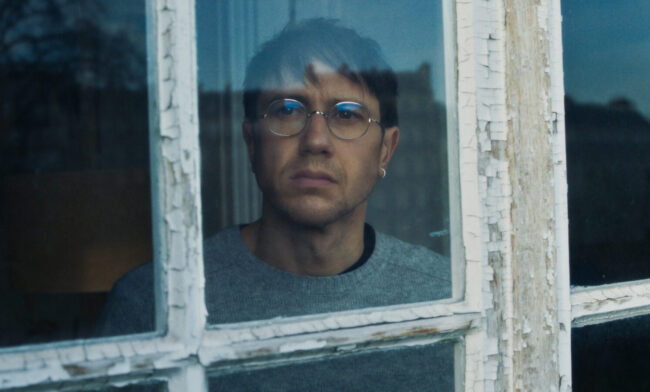
À Pied d’Oeuvre by Valérie Donzelli. Photo credit: DIAPHANA DISTRIBUTION
The film winds up with a host of ironies (which I liked), and some flatulent sentimentality (which I didn’t). When his son calls to say he’s read his work and loved his turns of phrase, I expected Paul to be flustered at how his flesh-and-blood may not really “get” his writing — or has his own particular take. Instead, tears flood his eyes. Often I’m a sucker for fake emotion, but this time I wanted to offer him eye-drops. This is made up for by a delirious, genuinely startling episode concerning road kill butchering that serves as a sort of climax.
I’ve appreciated Valerie Donzelli as a solid character actress (even in limited roles, as in Cédric Kahn’s Making Of), but wasn’t as familiar with her directing. (The Cinémathèque recently ran a retrospective of her work.) She takes real risks in A Pied d’Oeuvre: Of falling into so-called misérabilisme (wallowing in the lower depths, aka slumming). Another is degenerating into silly farce as we follow Paul in jobs that he’s not experienced in or qualified for. I had a gnawing memory of a film on a similar theme, and it finally came to me: Hardly Working, one of Jerry Lewis’ worst movies. Ms. Donzelli is more subtle than that. A Pied d’Oeuvre is also more thought-provoking than a blatant film social would be. Just like her protagonist after all his travails the film, despite some flaws, works.
Production: Pitchipoï Productions/France 2 Cinéma
Distribution: Diaphana
Lead photo credit : À Pied d’Oeuvre by Valérie Donzelli. Photo credit: DIAPHANA DISTRIBUTION
More in Bastien Bouillon, Valérie Donzelli
Related Articles