Paris Parks that Were Once Mines
- SUBSCRIBE
- ALREADY SUBSCRIBED?
BECOME A BONJOUR PARIS MEMBER
Gain full access to our collection of over 5,000 articles and bring the City of Light into your life. Just 80 USD per year.
Find out why you should become a member here.
Sign in
Fill in your credentials below.
Paris Mayor Anne Hidalgo recently added to the greening of the city with a new urban forest of trees and plants in front of the Hotel de Ville. But it was Napoleon III in the 1860s that launched the era of public parks in Paris, ultimately creating four large parks for the citizens of Paris, including two that were once mines.
Although the Tuileries by landscape designer André Le Nôtre was open to the public in the 17th century, most park-type areas were private, owned by wealthy landlords or royalty. According to Jacqueline Widmar Stewart in her book Parks and Gardens in Greater Paris, it was Napoleon III’s “plan to improve Parisian life” by cleaning up and beautifying Paris beyond Baron Haussmann’s elegant buildings and boulevards. He wanted to build parks “that were treasured by both rich and poor.”
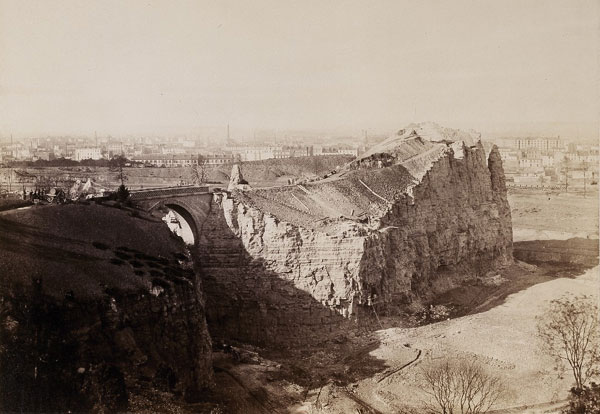
The Parc des Buttes Chaumont under construction. Photo: Charles Marville, Bibliothèque nationale de France. Public domain
Parc des Buttes Chaumont
The Parc des Buttes Chaumont located in the 19th arrondissement is a perfect example of creating a park for Paris citizens out of an area that was an abandoned mine. Buttes Chaumont also has a gory history. On its bare hill sat the main gallows for the French kingdom, the place of execution by hanging for criminals and traitors. There was also a gibbet where dead bodies were hung and displayed, sometimes for years. That stopped in 1760, but after the 1789 Revolution it became a dump for refuse, sewage and a place for cutting up horse carcasses and dumping other dead animals.
The mining area in Buttes Chaumont was a quarry that produced limestone and gypsum and dates to the Roman times. When gypsum is heated to 120ºC, it becomes plaster which is the origin of the term Plaster of Paris. The quarry operated until 1860 when it was depleted but centuries of mining left a bare, lunar landscape. There was no soil, only slag. Enormous hollows and caves cut into the buttes and scarred the bleak mountain, providing the hill its name – Chauve-mont or bald hill.
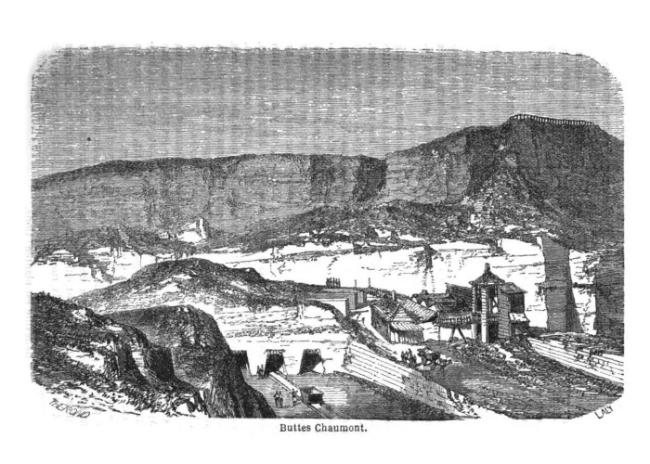
The quarries which occupied part of the site of the Buttes Chaumont. Laly Thérond – Adolphe Laurent Joanne, ‘Paris illustré: nouveau guide de l’étranger et du Parisien’, 1863. Public domain
It was Baron Haussmann, the prefect of the Seine, who selected the site for this new public park. The 19th and 20th arrondissements of Paris had been annexed to the city in 1860, and Napoleon III agreed that creating this huge area as a public park for the communes of Belleville and La Villette fit into his plan to offer green spaces to the working classes.
Starting in 1864, it took two years to excavate the 61 acres (24.7 hectares) of land and clean up the area. A light railway was built to take out excavation rock and bring in land fill. Roads and paths were built and in the center of the park was dug a five acre (two hectare) lake with an island in the center created from the old gypsum quarry. Two bridges lead to the island including one designed by Gustave Eiffel of Eiffel Tower fame. There is also a grotto with waterfalls in another part of the old gypsum and limestone quarry on the south side of the park. It was decorated with artificial stalactites up to eight meters high to make it look like a natural grotto. An artificial waterfall fed by pumps cascades from the grotto into the lake.
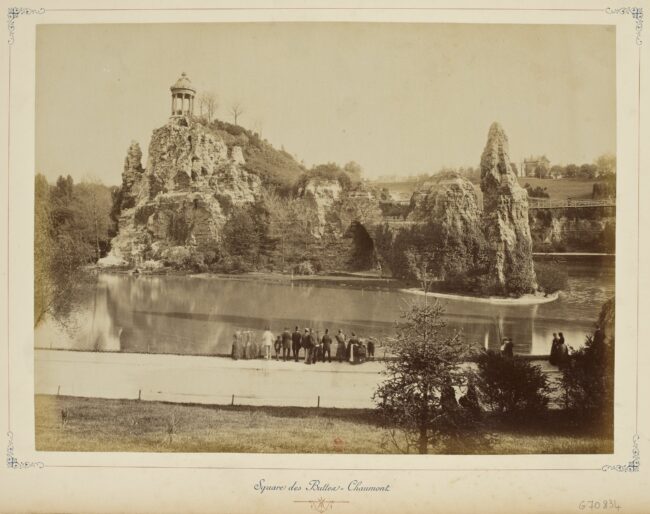
The Belvedere island in 1890–1900. Photo: Bibliothèque nationale de France, public domain
The island features several paths and a staircase leading to a 90-foot rocky peak where a miniature Roman temple called Temple de la Sybille was built. It was designed by Gabriel Davioud, the city architect for Paris, and is a miniature version of the ancient Roman Temple of Vesta in Tivoli, Italy, which was the subject of many romantic landscape paintings in the 17th to 19th centuries. Davioud also created cafes, bandstands, pavilions, gatehouses and bridges inspired not only by Rome but by the Swiss style of chalets and bridges.
Then the gardeners, headed by Jean-Charles Adolphe Alphand who worked with Haussmann designing the tree-lined promenades of Paris, went to work. It took another year to plant trees, shrubs, foliage and grass. The trees are both indigenous and exotic including Ginkgo Biloba, Siberian elms, European hollies and a Giant Sequoia.
The Parc des Buttes Chaumont opened on April 1, 1867 in time for the opening of the Paris Universal Exposition or World Fair. It was enthusiastically accepted and visitors filled the park. It is currently the fifth largest park in Paris. Walkers, runners, bikers and dogs on leash are allowed and there are several restaurants with views of the lake, the waterfalls and the vast expanse of parkland.
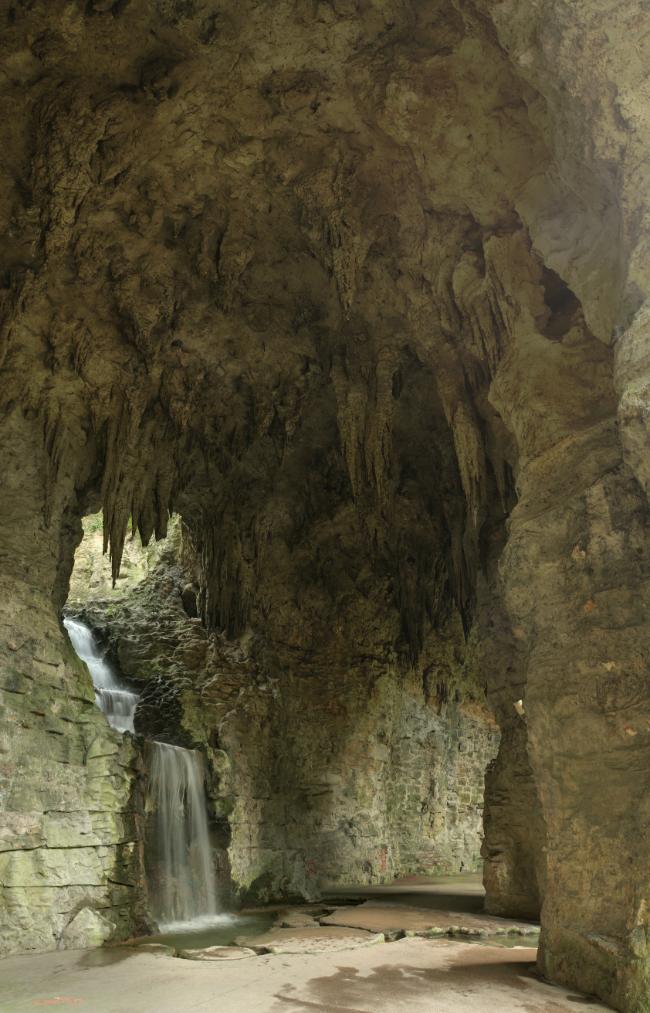
Parc des Buttes-Chaumont grotto. Photo: Coyau/Wikimedia Commons
The park was featured in the French TV series L’Art du Crime (The Art of Crime.) At the beginning of episode three of season two, a man is found murdered at the Temple de la Sybille on the island. Investigators Captain Antoine Verlay and art expert Florence Chassagne solve the crime using hints on postcards sent to Verlay featuring art by French artist Gustave Courbet. Courbet led the Realism movement of 19th-century French painting and the art crime team find clues in Courbet’s realistic paintings that provide clues to the murderer’s plan.
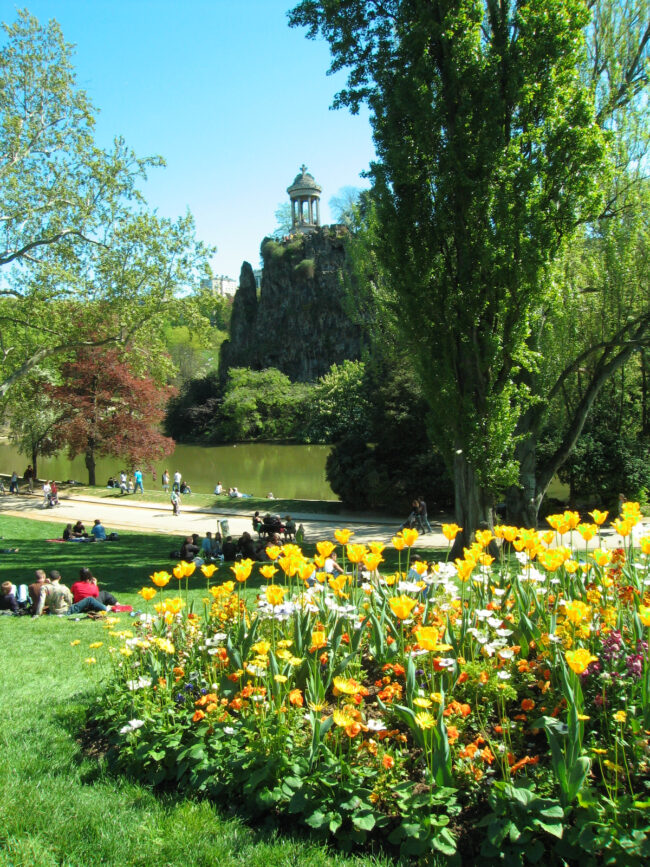
Parc des Buttes Chaumont and the Temple de la Sibylle. Photo: Jean-Louis Vandevivère / Wikimedia commons
Parc Montsouris
The second park created from an old mining area is in the southern part of Paris, the 14th arrondisement. The Parc Montsouris area was made of four stone quarries that resulted in huge, deep caves and tunnels and there was no vegetation or trees. In addition, two railroad lines ran through the park area including the Petite Ceinture line. It ran from 1852 to 1934 and connected the five main railroad stations of Paris.
There was a creepy side to Parc Montsouris too. The abandoned mines were filled with human skeletons as the tunnels were a part of Paris’ ossuary, called the catacombs. Before construction of the park could begin, hundreds of skeletons were removed and placed in other areas of the catacombs.
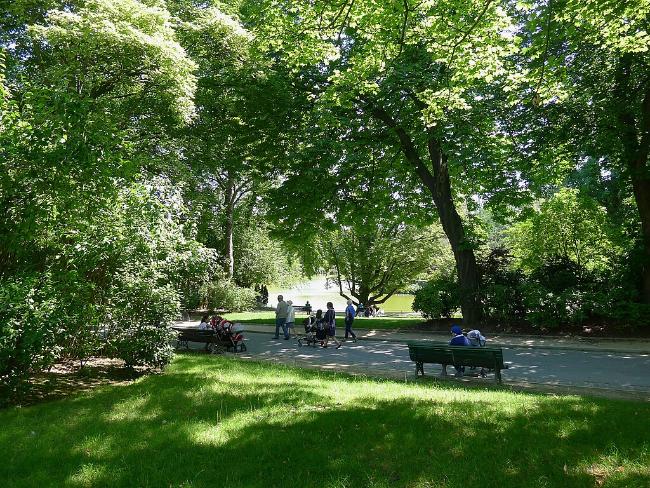
Alley in Parc Montsouris. Photo: Mbzt/ Wikimedia commons
Work started in 1867 on the 37.5 acre (15 hectares) park. The quarries were filled in to stabilize the terrain and the two railway lines were creatively hidden while allowing the Petite Ceinture to continue running. A two and one-half acre lake was dug along with building a cascade of rocks and cement for the waterfall that was the source of the water for the lake. Stairways were constructed to climb up hills along with winding roads and paths. Davioud designed and built bridges, gatehouses, pavilions, a theatre, bandstand and café that graced the area.
When the building was mostly done, Alphand and his gardeners began planting sweeping lawns, groves of trees and hundreds of shrubs and flowers. It wasn’t until 1878 that the park was officially completed, although there was an early opening in 1869. The lake, waterfalls and foliage today attract some 40 species of ducks, geese, swans and migratory birds. There are even turtles imported from Florida that often sunbathe on the stoney shores of the lake.
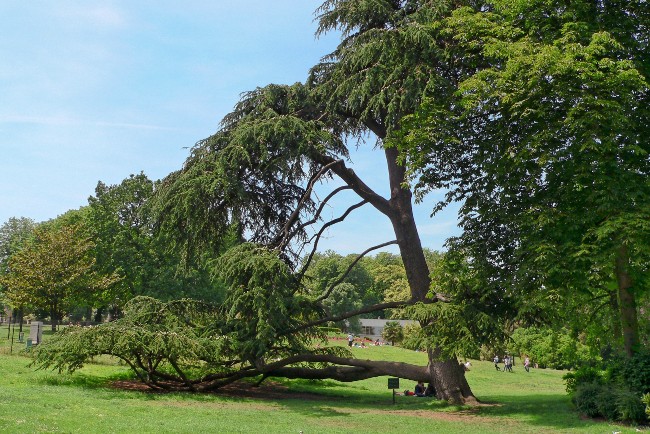
Cèdre du Liban, The trees of Parc Montsouris. Photo credit: besopha/ Wikipedia commons
The name Montsouris is a rework of the word Moquesouris, or mouse rocker. It is a reference to the ancient name of the area that once had windmills that were attractive to mice. The windmills were abandoned long before the area was a mine.
There are a variety of statues in the park including one called “Mine Accident” (L’accident de carrière) by Henri Bouchard. It is a scene of two miners carrying a comrade on their shoulders out of a mine or quarry in which he had died. The marble sculpture was placed in Parc Montsouris in 1910.
The park has a theater, bandstand and several cafes. Bikers, runners and those just wanting to walk can enjoy the lake that hides the old quarry as they then travel on to sloping lawns and flowerbeds.
The two mining parks are one of four urban public parks that Haussmann and Napoleon III created at the four compass points of Paris to provide green spaces and recreation for visitors and citizens of Paris. The western point park is Bois de Boulogne and the Eastern park is the Bois de Vincennes. Today, the parks continue to provide a cool place to spend a hot summer day, but the northern point Parc des Buttes Chaumont and the southern point Parc Montsouris prove that even the destruction caused by tearing up land for mining can be recreated into alluring parks.
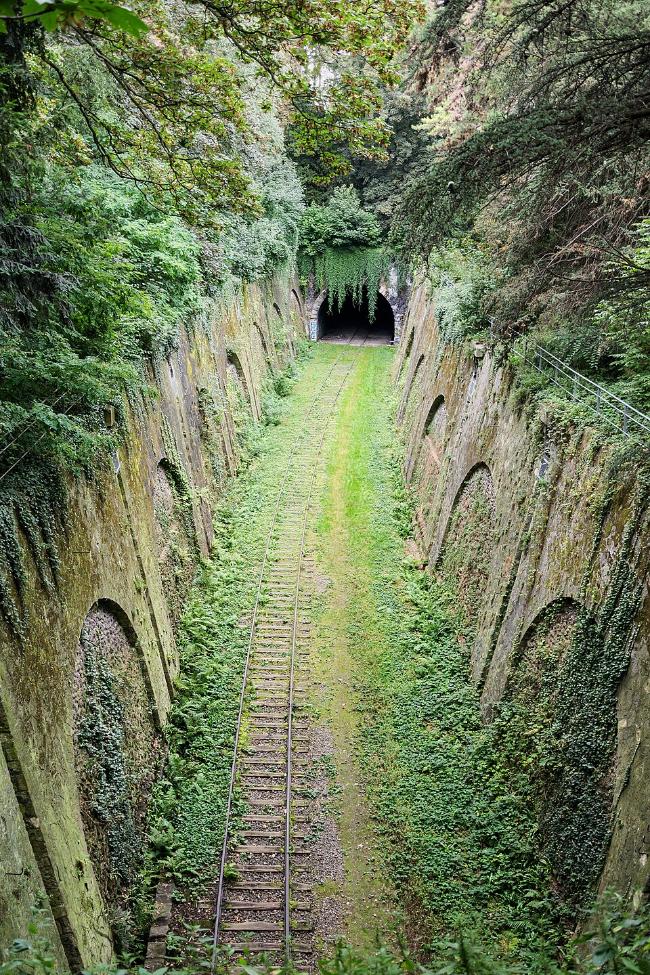
The Petite Ceinture train line in the parc Montsouris. Photo: Myrabella/ Wikimedia Commons
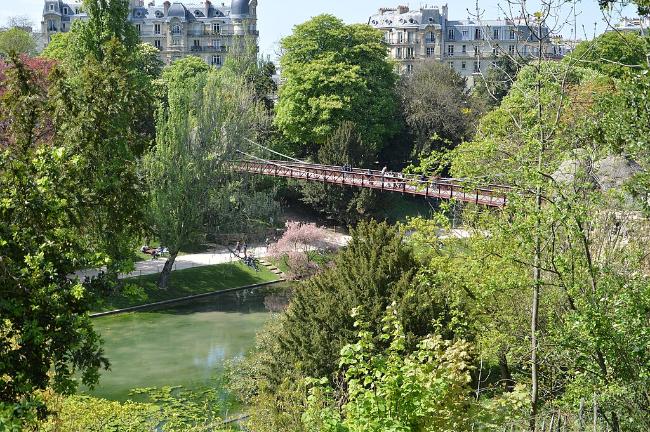
Lead photo credit : Suspended footbridge in the Parc des Buttes Chaumont. Photo: Clem/ Wikimedia Commons
More in haussmann, mines in Paris, Napoleon III, Parc des Buttes Chaumont, Parc Montsouris
Related Articles