Rudolf Nureyev’s Kilim-Covered Grave in the Russian Cemetery
- SUBSCRIBE
- ALREADY SUBSCRIBED?
BECOME A BONJOUR PARIS MEMBER
Gain full access to our collection of over 5,000 articles and bring the City of Light into your life. Just 80 USD per year.
Find out why you should become a member here.
Sign in
Fill in your credentials below.
Just 30 minutes from Paris by train, in the medieval-era town of Sainte-Geneviève-des-Bois, is a compelling and unexpected site. For it’s here — not far from the grotto where it’s said Saint Geneviève conjured a miraculous, thirst-quenching spring in the year 448AD — that the largest Russian Orthodox cemetery outside of Russia is situated. Its origins go back to 1927, when it was created for the burials of the White Russians who had fled the Bolshevik Revolution.
Land from the Cimetière de Liers was granted to an English benefactress, Dorothy Paget, who had already set up a retirement home for Russian émigrés with her sister, Princess Vera Meshchersky and Elena Orlov, in the nearby Chateau de la Cossonerie. There are around 5,000 graves, including many famous figures like Prince Felix Yusupov, Ivan Bunin (Nobel Prize for Literature 1933), ballerina Olga Preobrajenska, chemist Alexsei Chichibabin, artist Serge Poliaoff, and, of course, the most famous grave of them all, that of the most famous ballet dancer of all time, Rudolf Nureyev.
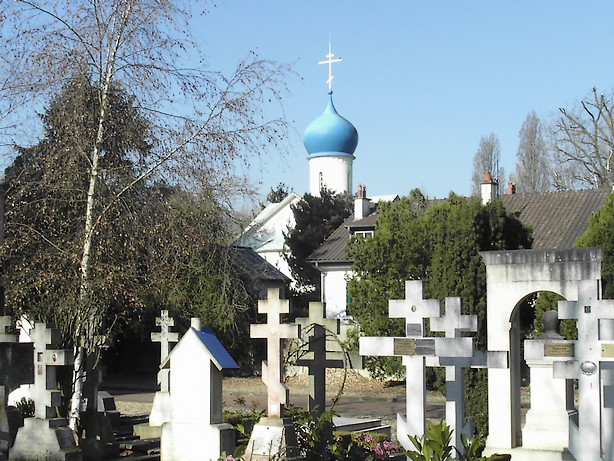
The Russian cemetery and the église Notre-Dame-de-la-Dormition. Photo: Olivier Perrin/ Wikimedia commons
Here’s his story, and why you should visit the mysterious Russian Cemetery, distinguished by the orthodox church’s onion dome, Cyrillic tombstones, and lush trees planted in the Russian tradition.
Nureyev was born on the trans-Siberian railway, somewhere near Lake Baikal, on March 17, 1938. The trans-Siberian express was no longer as it had been advertised at its inception in the 1890s, when it boasted sumptuous sleeping and dining cars, a salon with a grand piano, libraries filled with French and Russian books, and even a carriage made up as a church complete with icons. Instead it was now a utilitarian steam locomotive, packed with freight and immigrants to populate the sparse areas north of Manchuria, and hundreds of thousands of political refugees on their way to some 33 gulags that were located along the railway route.
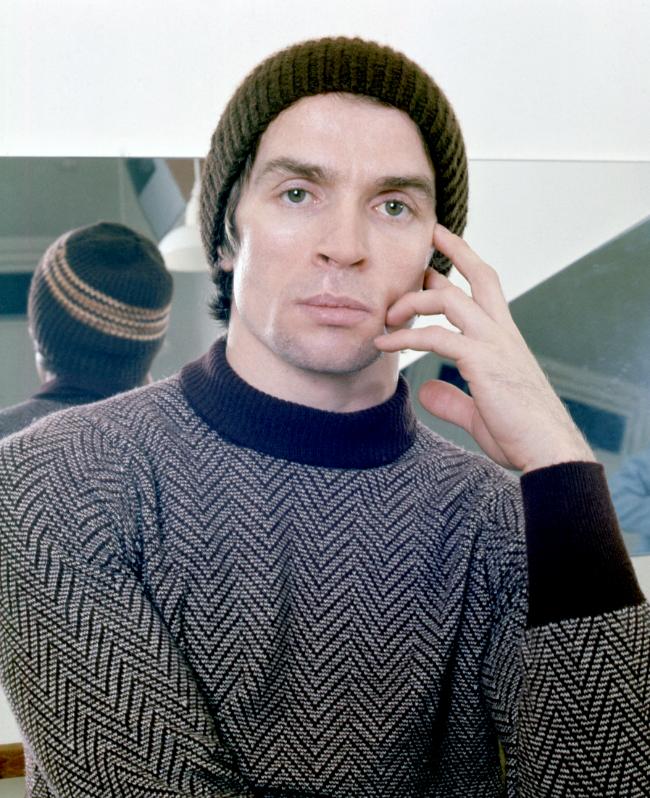
Rudolf Nureyev in his dressing room at the Royal Ballet School, 155 Talgarth Road, Barons Court, London. Photo: Allan Warren/Wikimedia Commons
Eight months pregnant, Nureyev’s mother Farida took the 3000 miles journey from Ufa to Vladivostok sitting upright on a hard seat, along with her three other children. Nureyev later said of his birth that he liked to think of it as the most romantic event in his life. It is doubtful his mother would have agreed.
Despite being of Tartar peasant stock, Yureyev’s father Hamet became a political education officer in the Red Army. For a while, the family lived a not uncomfortable life in Moscow, but by 1942, WWII was to force Hamet to the Ukrainian front, and Farida and the family back to Ufa.
Their new home was a room of 9 square meters shared with Farida’s brother and another family. This was grinding poverty at its worst. Farida walked miles in the freezing cold for potatoes, selling what little clothes they possessed, and all the time living in a suffocating proximity where any kind of privacy was impossible.
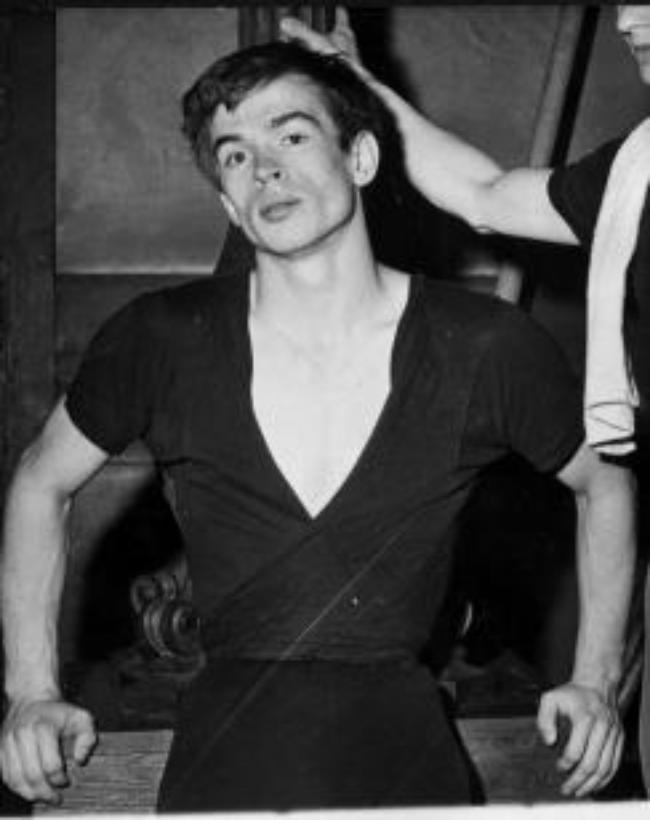
Rudolf Nureyev after his defection from the Soviet Union in 1961. Photo: Pressens Bild/Scanpix/Wikimedia Commons
But it was in this most unlikely of settings that Nureyev started to dance in the local kindergarten. He was noticed straight away, the troupe were given costumes and danced Tartar, Bashkiri and Russian dances, often performing in hospitals in front of wounded soldiers. They were even filmed for a trailer, and went to see themselves on the big screen in the Octyabr Cinema.
However, it was New Year’s Eve 1945 that was to irrevocably shape Nureyev’s life. With just one ticket, Farida managed to smuggle the whole family in to the sold-out ballet, The Song of Cranes, at the Ufa Ballet. Nureyev was only seven years old but knew at that moment he had been called to dance.
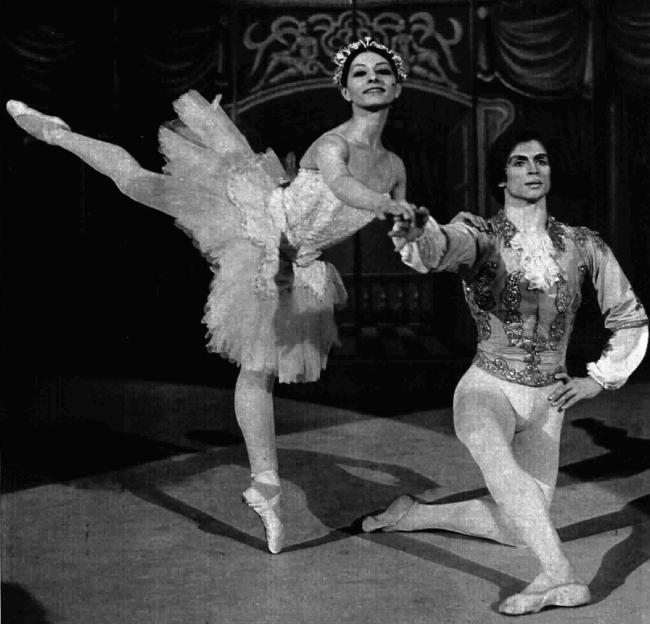
lNureyev with Liliana Cosi in Rome, 1972. Photo: Unknown author/ Italian magazine Radiocorriere/ Wikimedia Commons
He was passed from one dance teacher to the next, each acknowledging his special talent and each concerned about his volatile temperament. An added problem was his father Hamet, who was adamantly opposed to his son becoming a ballet dancer. Their relationship was strained; Nureyev simply ignored his wishes and sneaked off to practice whenever he could. At 16, he was offered a position in the Corps de Ballet in the Ufa Ballet. The following year, he was accepted at the Vaganova ballet school in Leningrad. Besides his phenomenal raw talent, he had much to learn. His temper, and often foul– mouthed outbursts, proved impossible to tame.
By 1961, Nureyev was dancing for the Kirov Ballet and was chosen at the last minute to go on tour with them to Paris and London. There are differing theories about his defection. Was it really a last-minute decision, or had he always planned to defect? Whatever the truth, the facts are that at Le Bourget airport in Paris, he was informed that he would not be following the company on to London, but instead would be going to Moscow for a couple of days. Nureyev had no doubts what this meant, with two KGB agents standing beside him. He made a run towards the two French policeman who had been forewarned that he wanted to defect, but had to hear the words from Nureyev’s lips. It was a momentous decision – never to return to your homeland – indeed the chances of a fatal retribution was more than a possibility, and the knowledge that his family would be made to suffer was an absolute certainty. Nureyev had 45 minutes in police custody to decide. At 1:10pm the Tupelo left Le Bourget airport for Paris.
Nureyev was not onboard.
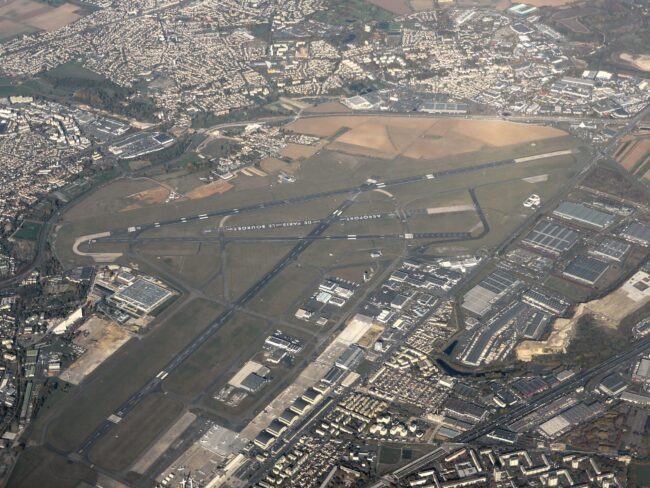
Aerial view of Paris-Le Bourget airport. Photo credit: Citizen59 / Wikimedia commons
The news of Nureyev’s defection exploded all over the world. In Russia, there was a total blackout. (He was not allowed to return to Russia for another 28 years to see his dying mother and dance once more at the Kirov Ballet in Leningrad.)
In Paris, while the Kirov company were performing in London without Nureyev, he was dancing at the Théâtre des Champs-Élysées. He was understandably nervous, the theater was surrounded by police and the auditorium populated by plain-clothed police for extra security. He had no need to worry. His performance was stopped four times by rapturous applause; there were 30 curtain calls and the clapping lasted 15 minutes.
Nureyev was about to become the most famous ballet dancer in the world
Over the next almost 30 years, Nureyev danced all over the world, amassed a fortune, bought houses in London, New York, St Barts and Paris. He was feted and had friendships with film stars, pop stars and royalty. His fame never diminished, his status, never questioned, but it was undoubtedly his partnership with Margot Fonteyn, almost 20 years his senior, that cemented his reputation as the most exciting, acclaimed dancer the world had ever seen.
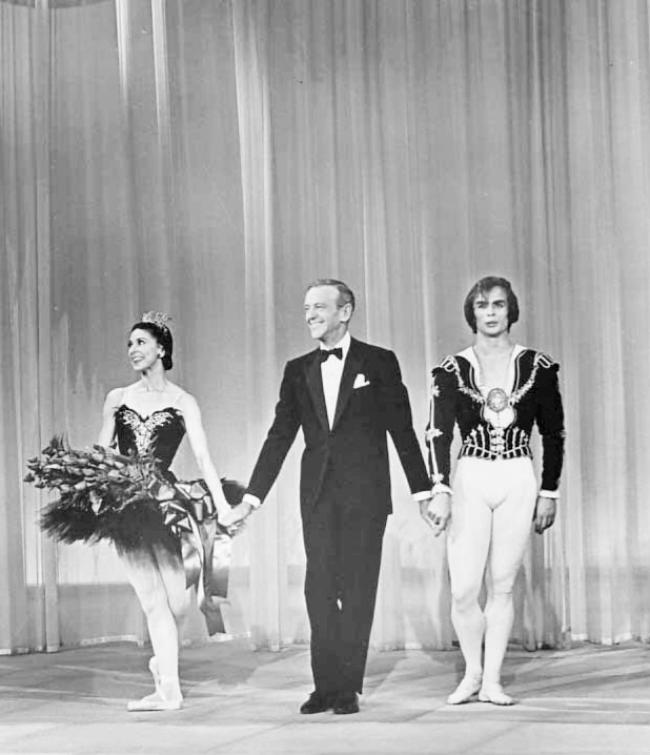
Margot Fonteyn, Fred Astaire and Nureyev from a 1965 appearance on the U.S. television show The Hollywood Palace. Photo: ABC Television/ Public domain
Fonteyn, on the verge of retirement, was in need of some persuading to agree to perform with this young Russian dancer. They had already met in London, and had got on exceptionally well, but dancing together? Fonteyn feared she would be eclipsed by Rudolf, compared as mutton next to lamb, but finally she agreed and on the 21st of February 1962, Fonteyn and Nureyev danced Giselle at The Royal Opera House. It was a triumph. Thirty curtain calls after a stunned four-second silence. Nureyev had made the part of Albrecht uniquely his own. Dancing with Fonteyn he said, was as if they were one body and soul. They were to remain the closest of friends their entire lives. In 1964, they danced Swan Lake in Vienna. The 89 curtain calls for their performance still remains an unbeaten record. (There was always speculation they had been lovers. In Peter Watson’s extensively researched biography, he states that during a three–week tour of Australia, Fonteyn and Nureyev were certainly lovers.) Nureyev slept with very few women; he was predominantly homosexual and becoming more and more promiscuous. It was for Nureyev, as with many before him, to prove fatal.
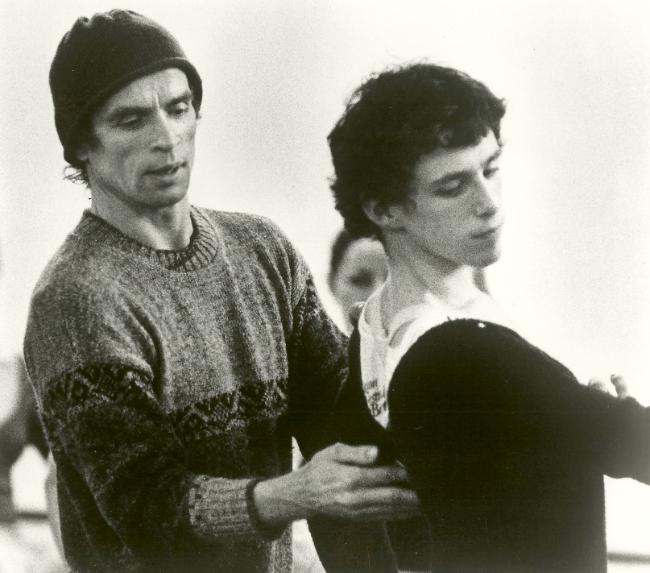
Devon Carney and Rudolph Nureyev in rehearsal for Don Quixote. Photo: KCBalletMedia/ Wikimedia Commons
His last ballet was La Bayadère at the L’Opera Paris in 1992, but before that in 1983, he accepted the position of director of the Paris Opera Ballet, the oldest ballet company in the world. Nureyev spent his final years there challenging the hierarchical system he’d always hated, nurturing young talent and following his passion for precisely engineered, meticulously crafted costumes. He adored sumptuous decoration, embroidery, jewels and braid.
When he bought his apartment at 23 Quai Voltaire, opposite the Louvre, he collaborated with the Italian designer Emilio Carcano. The result was an opulent, eclectic space, rich with decoration and Nureyev’s personal taste of central Asian kilims, Ottomans, French antique furniture, Islamic ceramics and Russian icons. Some of the walls were clad with leather, tapestries and a neo-Gothic frieze.
In 1981, the first intimations of a strange new disease began to circulate. It was a rare form of cancer known as Kaposi’s sarcoma, and had been found in homosexual men. It was not until 1984 that Nureyev consulted a French doctor, Michel Canesi, about his night sweats. He was then referred to Dr Willy Rozenbaum, probably the most experienced AIDS doctor in France working at the Pasteur Institute in Paris. Canesi was given the grim task of telling Nureyev that indeed he was HIV positive. It was an indication of Nureyev’s strength and fitness that he continued working, and even at aged 52, still danced more nights than he didn’t. Fonteyn died in 1991, around the same time that Dr Canesi noticed a change in Nureyev. He was losing weight, his skin had changed – all the signs of succumbing to full blown AIDS. His stoicism and bravery over the next two years were nothing short of astounding but finally on January 6th 1993, Nureyev breathed his last.
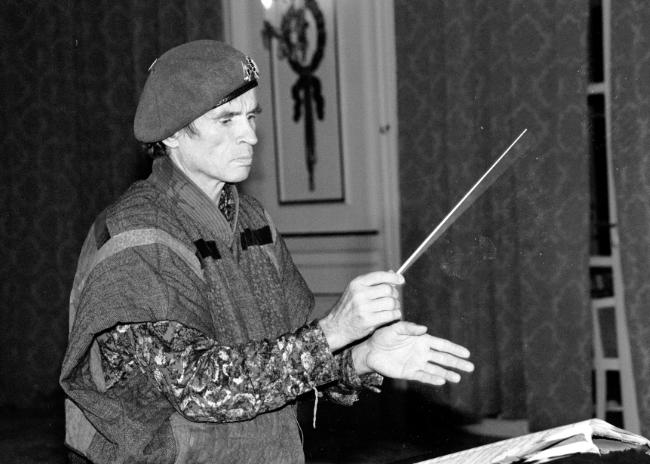
Nureyev’s first time conducting an ensemble, in Deauville, France (1991). Photo: Roland Godefroy/ Wikimedia Commons
His coffin was taken to the Palais Garnier on the 12th of January and carried up the steps by six dancers into the foyer next to his Legion d’Honneur and Chevalier’s Cross and his sash as Commander of Arts and Letters. The coffin was then taken to the Russian Orthodox cemetery in Sainte-Geneviève-des-Bois, where a quartet played Adam’s music from the last act of Giselle. He was buried in his evening clothes with his ballet shoes beside him.
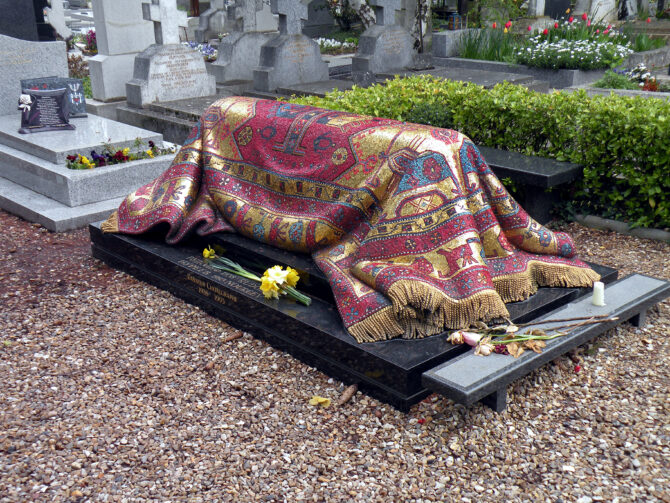
The covering of Nureyev’s grave was designed by the renowned Italian costume designer, Ezio Frigerio, with whom he had collaborated on many occasions.
It is a masterpiece, made of thousands of tiny, colored ceramics. From a distance it is impossible to discern that it is not a rug, one of the brightly colored kilims that Nureyev loved. It hangs over the coffin to the ground, draped and folded with gold tassels: a burst of vibrant, exotic color and life in a place of sorrow.
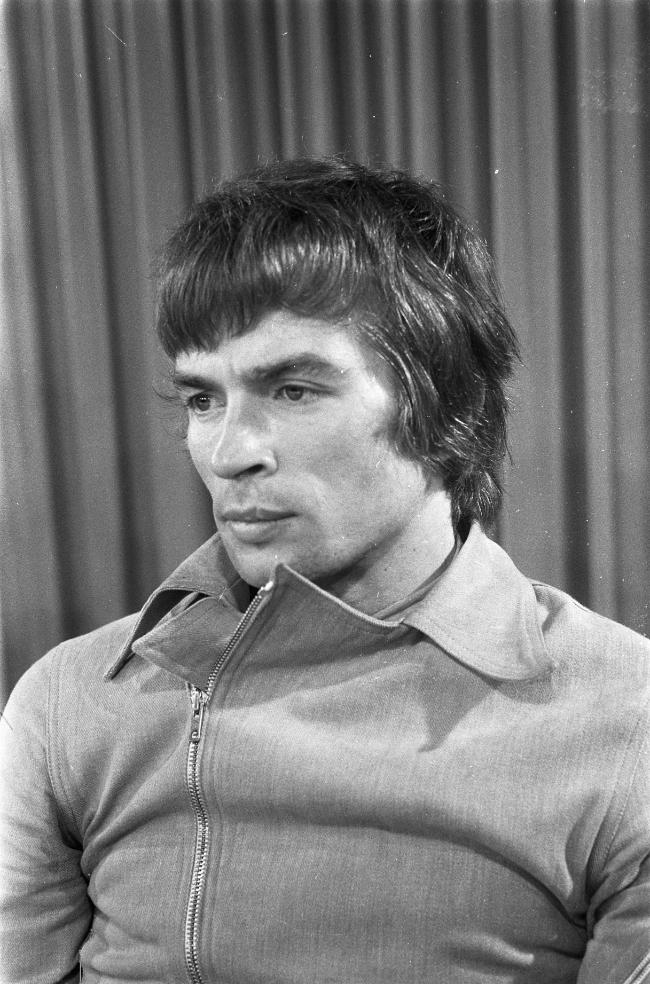
Rudolf Nurejev. Photo: Eric Koch for Anefo/Wikimedia Commons
Lead photo credit : Rudolf Nureyev's tomb. Photo: Vitold Muratov / Wikimedia commons
More in ballet, Rudolf Nureyev, Russian Cemetery, Sainte-Geneviève-des-Bois
Related Articles