
The Louvre’s Stolen Jewels: A Tale of Queens and Empresses

It was, said President Macron after the recent jewelry theft at the Louvre, “an attack on our history.” Knowing a little about the four queens and empresses whose treasured jewels were stolen adds color to the turbulent history of 19th century France. During that period France was variously a monarchy, a republic and – twice! – an empire and each of these women influenced that narrative, even though three of the four were foreign born and all of them ended their days in exile. Here then are the stories behind the stolen jewels and their owners, the empresses Marie-Louise and Eugénie and queens Hortense and Marie-Amélie.
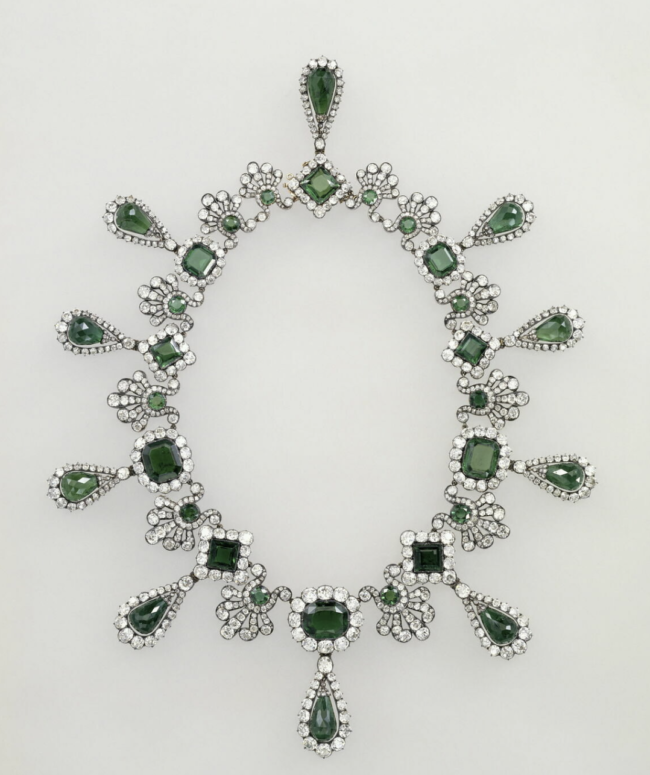
Empress Marie-Louise’s emerald necklace. Photo: © 2004 GrandPalaisRmn (musée du Louvre) / Jean-Gilles Berizzi
Stolen! Empress Marie-Louise’s emerald necklace and earrings
These stunning pieces were part of the “parure” or matching jewelry set given to Marie-Louise, Archduchess of Austria by Napoleon on the occasion of their wedding in 1810. The necklace alone features 32 emeralds and over a thousand diamonds.
Marie-Louise (1791-1847) was Napoleon’s second wife, chosen by him – without meeting her first! – for her royal blood and in the hope that she would bear him an heir, something which his first wife, Josephine, arguably the love of his life even after their parting, had been unable to do. Marie-Louise was only 19 and the historian Evangeline Bruce describes her “terror” when she learned of her forthcoming marriage to “a divorced and excommunicated old man old enough to be her father, the enemy of her country and the sovereign of a people who had beheaded her own great aunt.” The aunt, of course, was Marie-Antoinette.
However, the marriage seemed quite successful in the early days. Napoleon took an extended honeymoon, reducing his commitments for at least a year and the Austrian diplomat Metternich wrote that the emperor was “so evidently in love with her that all his habits are subordinated to her wishes.” When, a year later, the birth of the heir Napoleon had so longed for proved difficult, doctors in attendance told the emperor that both mother and child were in danger. He replied without hesitation that they should, above all, “save the mother.” In fact, a healthy baby boy was eventually born and a celebratory 100-gun salute echoed out over Paris.
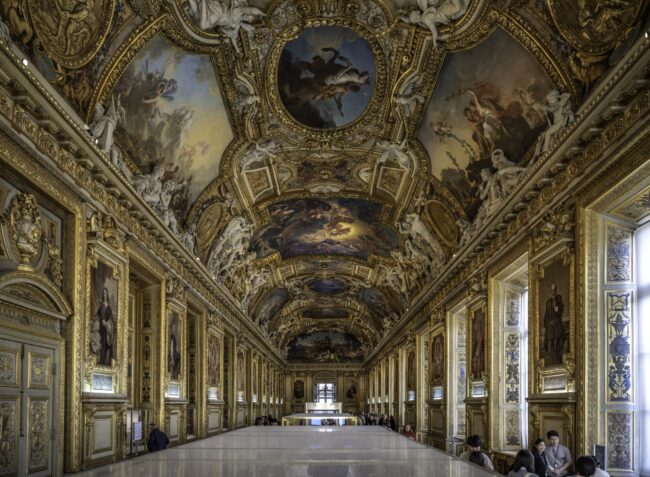
The Galerie d’Apollon in 2024. Photo: Wilfredo Rafael Rodriguez Hernandez / Wikimedia commons
Marie-Louise could be quite formidable, despite her youth and served, for example, as regent for Napoleon when he was away on campaign in Russia. But when it all went wrong, she looked out primarily for her own interests and those of their son, Napoleon-François-Charles-Joseph Bonaparte. The empire to which he was heir collapsed just three years after his birth and Marie-Louise retreated to Vienna, taking the child with her. She refused Napoleon’s entreaties to join him in exile, eventually becoming completely estranged from him. Bonapartists, including Napoleon’s brothers, wanted her to leave his son and heir in France, but she simply would not, opting rather for them to spend the rest of their lives in Austria. François Charles, who became the duke of Reichstadt, died of tuberculosis at the age of just 31.
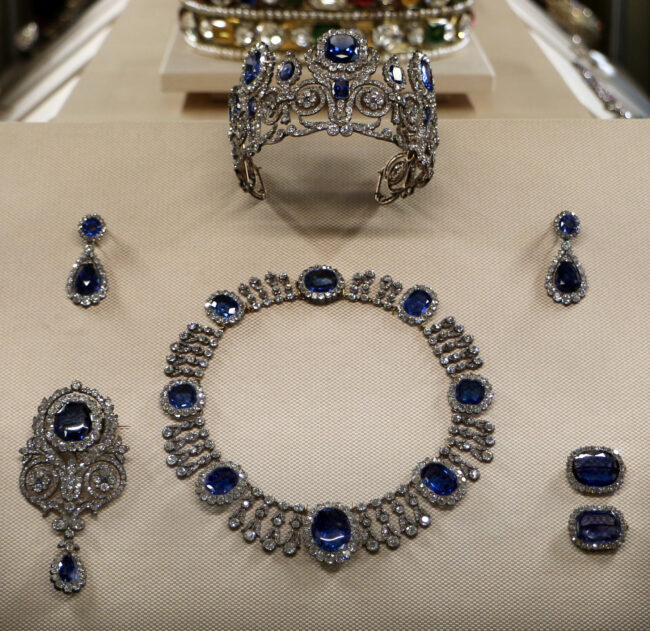
Sapphire set of Queen Marie Amélie bought back by the Louvre in 1985, parts of which were stolen in the 2025 Louvre robbery. Photo: Sailko / Wikimedia commons
Stolen! The Sapphire Treasures of Queen Marie-Amélie and Queen Hortense
The diamond and sapphire tiara, necklace and earrings – only one of which was stolen! – are said to have been worn by both Hortense de Beauharnais and Queen Marie-Amélie. The tiara features 24 Ceylon sapphires and over a thousand diamonds, the necklace a further eight sapphires and some 600 diamonds. The story of these fabulous pieces is hard to unpick. Hortense de Beauharnais, who became queen of Holland and Marie-Amélie, wife of Louis-Philippe, were born just one year apart. However, they were from rival families and thought to have met only rarely, so it’s not clear how the jewels were owned by both of them. Hortense died in 1837, but Marie-Amelie lived until 1866, so perhaps the pieces were owned by the latter after Hortense’s death. Originally, the set also included three brooches, a comb and two bracelets.
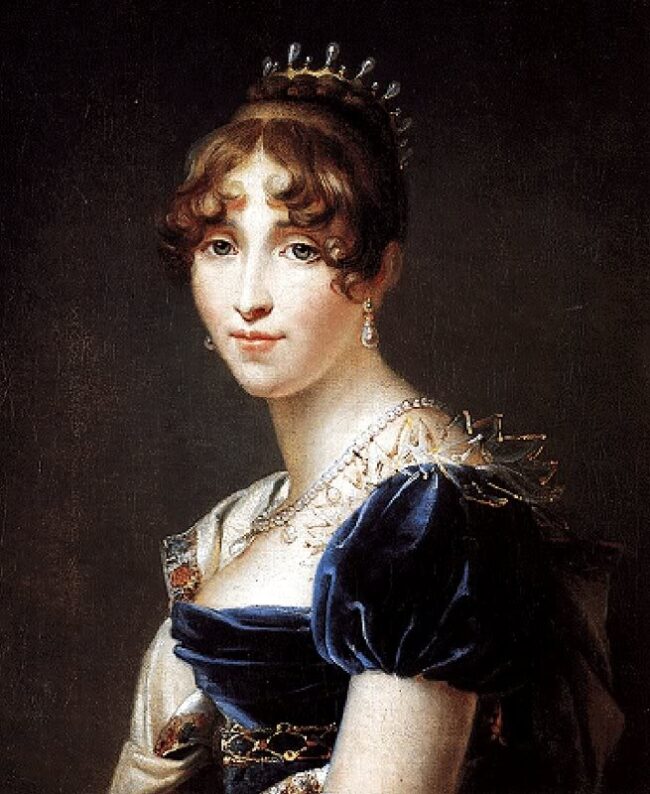
Hortense de Beauharnais par François Gérard. Public domain
Hortense de Beauharnais was the daughter of Josephine by her first husband and was a teenager when her mother married Napoleon who then adopted her. Aged 19, she married Napoleon’s brother Louis, who later became – briefly! – king of Holland, thus making Hortense his queen consort. It was an unhappy marriage, although they did have three children and the youngest, Charles-Louis Napoleon, went on to become Emperor Napoleon III. She remained loyal to the Bonapartist cause even during Napoleon’s exile from 1814. In fact, she was so involved in the plot to restore him to power that when it failed she was banished from France and lived out the rest of her life in exile in Switzerland. She died of cancer in 1837 and is buried in Rueil-Malmaison on the outskirts of Paris.
Marie-Amélie de Bourbon was born with royal blood, albeit Austrian, and was another of Marie-Antoinette’s nieces. She had Bonapartist links too because her niece was none other than the Empress Marie-Louise, but she married Louis-Philippe of the House of Orléans. When he became king after the July Revolution of 1830, she was granted the title “queen of France,” becoming the only woman ever to have held that title. However, she took little interest in politics, preferring to focus on raising their eight children and when Louis-Philippe was forced to abdicate after an 18-year reign, they left France for England.
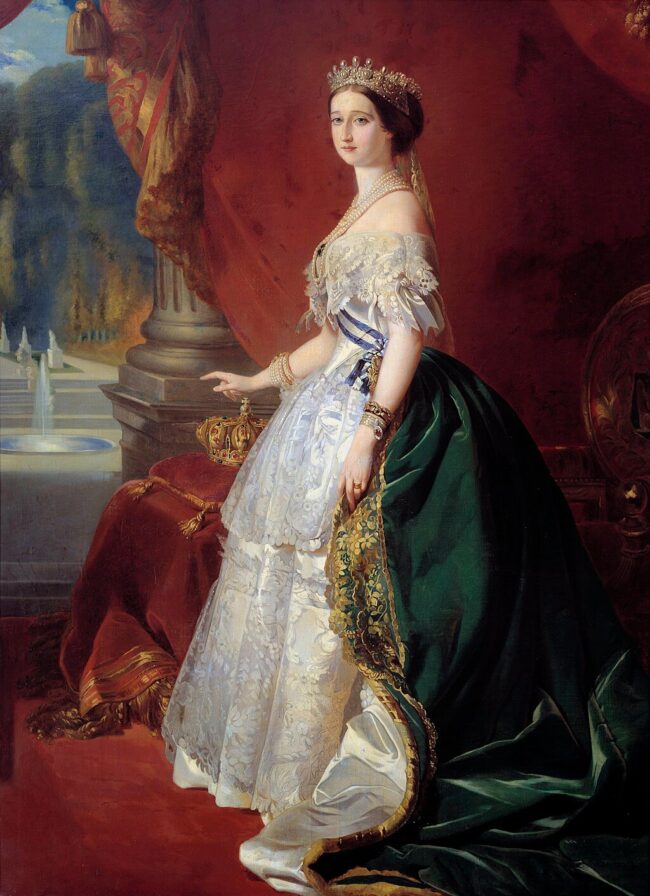
Portrait of Empress Eugénie in Court Dress. After Franz Xaver Winterhalter, between 1855 and 1870
Stolen! Empress Eugénie’s tiara and brooches.
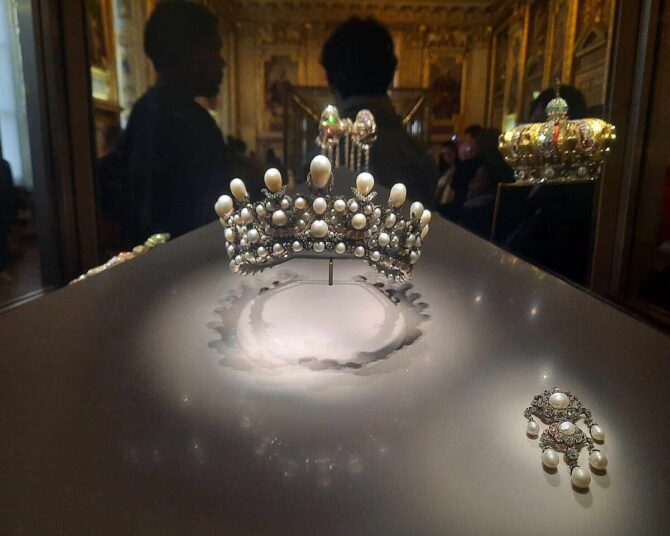
Two of the stolen items which once belonged to the Empress Eugénie were brooches, a “reliquary” brooch, designed to hold a sacred relic which is a testament to Eugénie’s strong catholic faith and a “corsage bow brooch” which was a fabulously opulent decorative item. Originally designed as the centerpiece of a belt, it was adorned with more than 4000 precious stones and was worn, for example, when the empress received England’s Queen Victoria at the Palace of Versailles in 1855. A few years later she asked designers to turn it into a “bodice brooch,” worn to gather the folds of her dress in at the waist and to add a cascade of diamond tassels. The third stolen item, her pearl tiara, was commissioned by Napoleon III as a wedding gift to her and it is just exquisite, comprising over 200 pearls and nearly a thousand diamonds.
Eugénie’s crown has been the most talked-about item taken in the heist, for its historical significance and also because it was recovered on the same day, lying damaged in a Paris street where, presumably, the thieves had dropped it. Known as a “consort headress,” it was worn on state occasions when she accompanied her husband, Emperor Napoleon III. His own crown was dismantled during the Third Republic, but Eugénie’s survived, leaving a tangible record of their reign. Eight eagle-shaped arches made of embossed gold rise up from a band set with emeralds and pearls and it’s topped with an emerald-encircled globe and a cross made from six exceptional diamonds known as “brilliants.”
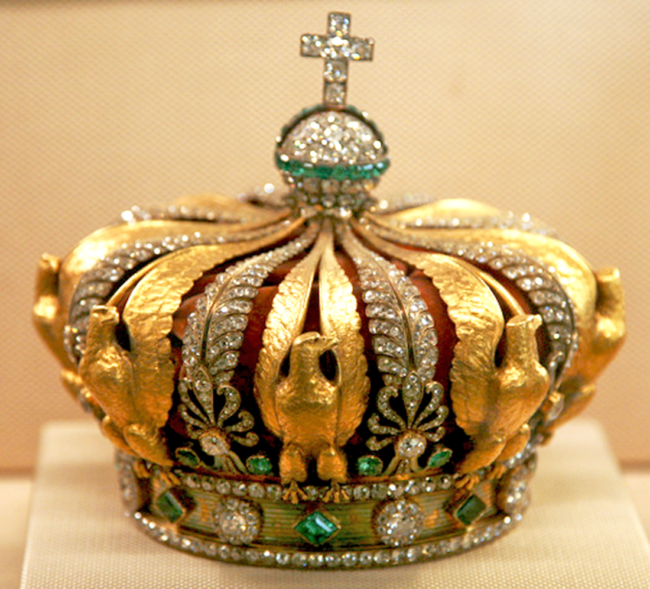
Crown of Empress Eugenie, part of the French Crown Jewels at the Louvre. Photo: David Liuzzo/ Wikimedia commons
Born Eugénie de Montijo in Spain in 1826, she married Napoleon III in 1853 and became the last person to bear the title empress of France. She was not just a figurehead, she served as regent for her husband in his absence and took an active interest in politics, hoping to preserve France as an empire and secure the future for her descendants, especially her only son, Napoléon-Eugène-Louis Bonaparte. However, it was a turbulent reign, and after France’s defeat to Germany in 1870 the imperial couple were forced into exile. They settled in England, but a double tragedy then befell her. Her husband died in 1873 and their son, now proclaimed by the Bonapartists as Napoleon IV, was killed on a military expedition to Zululand in 1879.
Empress Eugénie is remembered as a leading fashionista, said never to have worn the same outfit twice and was renowned for her expansive jewelry collection. Her style was keenly observed and copied by others, in fashion but also in other fields. She was a key force behind the extravagant decorative trend known as Second Empire style which you can still see today in the Napoleon III apartments at the Louvre. She was a patron of the arts and founded the Chinese Museum at Fontainebleau. In her long widowhood – she lived until 1920 – she traveled extensively, sometimes visiting foreign royalty, and presumably acutely aware that royal and imperial families were losing power all over Europe, for example in Russia, Germany and Austria-Hungary.
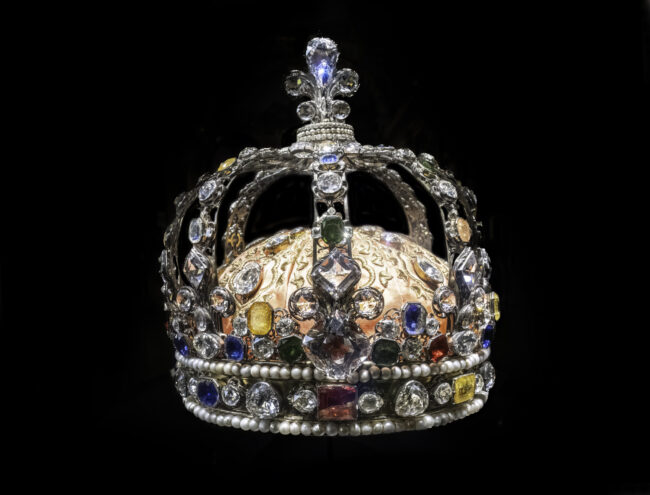
The crown of Louis XV. Photo: Wilfredo Rafael Rodriguez Hernandez/ Wikimedia commons
All is not lost!
The Joyaux de la Couronne de France, or French Crown Jewels, comprise pieces dating from 752, when the wonderfully named Pépin the Short was crowned king of the Franks, to 1870 when the Second Empire fell. The collection has been much depleted during the country’s fractious history, not least during the revolution of 1789 and again in the 1880s when much of what was left was sold off by the government of the Third Republic. However, some important pieces remain at the Louvre even after the recent theft, including Louis XV’s crown and other stunning pieces such as a tiara once owned by Marie-Antoinette’s daughter, the Duchess of Angoulême, and fabulous diamonds like the Hortensia pink diamond, cut for Louis XIV in 1678.
For now, it is unclear whether any of the stolen treasures will be recovered. It is definitely still worth visiting the Louvre’s Galérie d’Apollon, which you’ll find on Level 1 of the Denon Wing (Room 705) but entering it will now be a moment to reflect, along with France’s Interior Minister Laurent Nuñez, on what has been lost, namely “priceless” treasures of “immeasurable heritage value.” Knowing a little of the fascinating stories of the lost jewelry’s owners can only underline this poignant remark.
Lead photo credit : Empress Eugénie's pearl tiara on display at the Louvre. Photo: Orgio89/ Wikimedia commons
More in Empress Eugénie, French Crown Jewels, Louvre, Louvre heist, Napoleon
Related Articles

By Marian Jones