La Clef, Le Luminor, and the Movie Theater Crisis in Paris

An important reason for my settling in Paris years ago was the number of cinemas in the city. It was, and to a great extent remains, a movie buff’s paradise. I’m still stunned by the existence of scores of movie theaters (78 as of this year, for a total of 398 screens), of every conceivable kind. There are the chains like Gaumont, UGC and MK2 with their multiplexes. There are the surviving movie palaces (some more than a century old) like the Max Linder, Louxor and Grand Rex, and the art and revival houses (art et essai) that fill the Latin Quarter. There’s the magnificent Cinémathèque Française and futuristic La Géode.
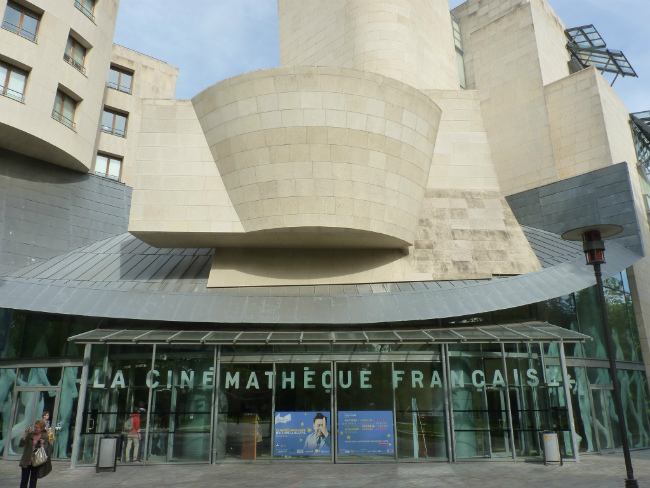
Cinémathèque Française, Paris by Luke McKernan/ Flickr
But the film exhibition sector in the French capital isn’t immune to the pressures weighing on movie theaters everywhere. The Covid pandemic locked the public out of them for two years, depriving them of revenue and changing the habits of the public. Netflix and other streaming services, not to mention improvements in home entertainment tech, make couch-potatoing more comfortable than ever. Increasing numbers of the young prefer to interact via their phones, while taking in various stimuli (or soporifics) over the same devices. Most insidious of all has been real estate speculation. Location, location, location means that prime real estate is better used (in the minds of the greedy) when dedicated to fast-fashion boutiques and/or luxury residences. As a result the numbers of cinemas have been sadly decreasing, along with several high-profile closings of well-known theaters.
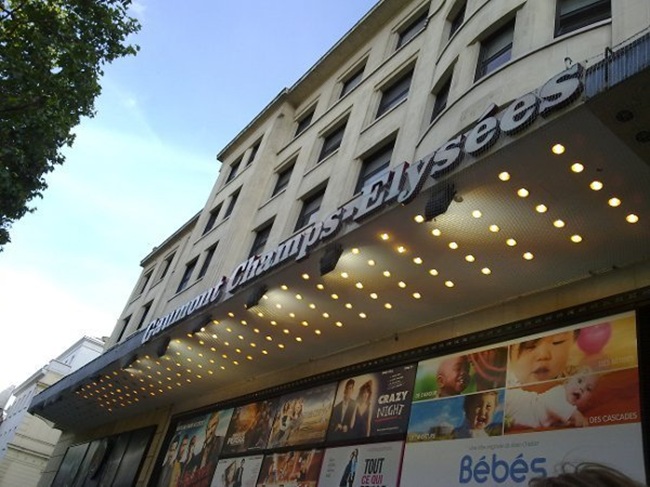
Gaumont Champs-Élysées Marignan in 2010. Photo: MissCookie1994 / Wikimedia Commons
Among the prominent cinemas to close in the last couple years was the Bretagne in Montparnesse, which had existed for 90 years. The Gaumont Champs-Elysée Marignan also closed, supposedly because structural issues precluded needed modernization work. (Pathé, which operated the cinema, wasn’t the owner of the physical premises.) Other theaters closed for renovations but reopened, albeit after several years. These include the Géode, a spherical structure that specializes in IMAX films, and the Pathé Palace at the Opéra. However, the reopening of the distinctive La Pagode, in the 7th arrondissement, with its Chinese-style architectural and landscaping design, has been postponed several times.
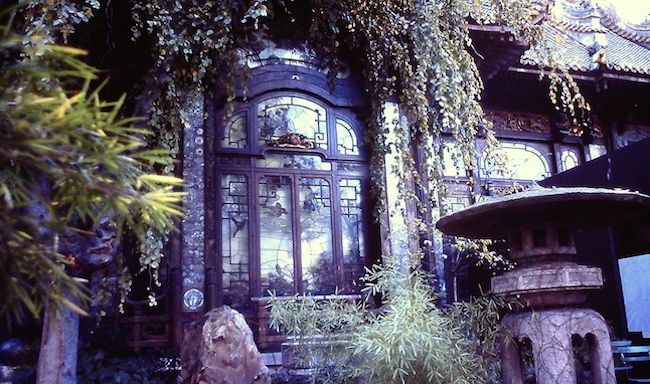
Cinema La Pagode in 1977, by Guerinf/ Wikipedia
But now for some good news. Once threatened, the art-house La Clef, located in the 5th arrondissement, near rue Mouffetard, has won its fight to stay open. It would have been tragic if the Latin Quarter had lost this beacon of film culture. For decades students at the Sorbonne frequented the theater, which has served as an unofficial Cinémathèque. For myself and many others it was the go-to place to discover alternative and international films.
Like some other classic Parisian cinemas La Clef has a storied past, but also a tumultuous one. Founded in 1973 by Claude Frank-Forter, the heir to a baby-clothes company, from the beginning it aimed at providing an outlet for foreign films, especially those made in the so-called Third World. While Frank-Forter has been portrayed as an eccentric benefactor, he’d attended a Paris business school, had the help of a friend who ran movie theaters, and worked with the UGC chain to set up his own theater. In a first-person account, Frank-Forter emphasized the professionalism that went into the cinema and the collaboration of distinguished individuals and institutions.

Cinéma La Clef. Photo credit: LPLT / Wikimedia Commons
Frank-Forter said that he had “seven good years” during the decade of the 1970s. Things went south at the beginning of the 80s, according to Frank-Forter, because of the improvements in television (color technology, etc), and the recourse of cinemas to expensive tech of their own (Dolby sound, wide screens). He sold the cinema to the works council (comité d’entreprise) of a major bank, what seems in retrospect like an odd transaction. Several years later, in 1990, the theater was taken over by a filmmaker and poet from Benin, Sanvi Panou, who showcased African and Latin American films.
La Clef was closed in 2009, and reopened in 2010 under the auspices of a non-profit, devoted to international and political films. The bank works council sold the premises (supposedly the council was dominated by leftist union reps, nevertheless they were swayed by the lack of revenue due to the cinema’s low rent). There were several operations to keep the cinema going, by members of the non-profit, then by cultural activists, who on occasion squatted the theater and screened movies illegally.
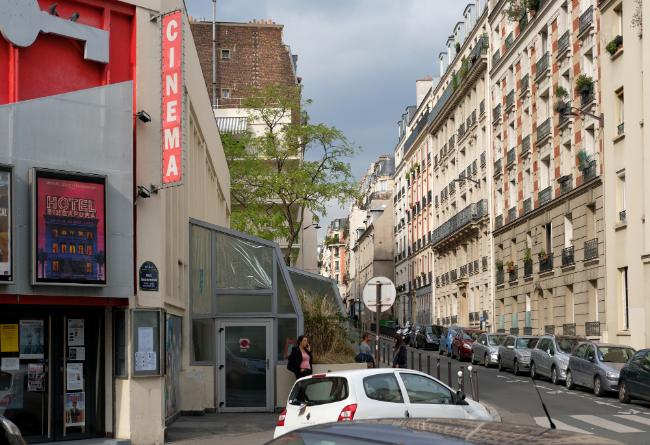
La Clef. Photo: Mbzt / Wikimedia Commons
Numerous organizations became involved: the oddly-named “Home Cinema”, the more aptly-named Groupe SOS, finally La Clef Revival. The latter group attracted support from the film and cultural world in France, from Agnès Jaoui to Mathieu Amalric, Léos Carax, Alain Cavalier, Irène Jacob, and Cédric Klapisch, and even celebrities from abroad, like Quentin Tarantino. Other major donors remained anonymous. The total needed to acquire the cinema was 2.7 million euros, of which 400,000 euros was raised by 5,000 small contributors. The organization was ultimately able to buy the cinema, renovate it during two years, and finally, this year, reopen with a slate of “engagé” films from emerging countries, including from Hungary Marta Massa’s Maja T. Extracts from the Trial, Deborah Stratman’s The Blvd (from Chicago, USA), Palestine: Methods of Struggle, by Mahdi Fleifel, Mohamed Mesbah, Kamal Aljafari, Augustino Comedi’s El Silencio es un cuerpo que cae (from Argentina).
Another beloved cinema, the Luminor, is still struggling to continue to exist. Located near Paris’ Hotel de Ville (city hall), the Luminor bills itself as “the last cinema of the Marais.” It is a classic art house showing arty mainstream movies, foreign films, and edgier avant-garde films. It also has taken on a pedagogical role to educate young people, with weekly programs for the young, as well as morning screenings for school groups.
In 2020, the owners of the building started eviction proceedings, which are still in progress. According to the cinema, it has respected the terms of its lease and isn’t in financial difficulties. Though the Luminor has the backing of the Paris municipality, it has no legal basis to contest the non-renewal of the lease. The corporate owner is ironically named Le Cinéma de l’Hôtel de Ville (CHV). The main shareholder of the CHV is Groupe SOFRA, a real estate holding company. They’ve been accused of planning to replace the cinema with shops and offices, though they claim not to have elaborated any specific plans for the premises. The group calls itself a “family business”; in fact it has links with the Seydoux and Schlumberger dynasties, and specializes in turning historical sites into tourist venues, in addition to more conventional hotel and real estate activities.
What’s the solution to the movie theater crisis? Not every cinema under threat can become a cause célèbre. For many of us the Luminor has been as important a source of ciné-culture as La Clèf but it doesn’t have the advantage of being located in the Latin Quarter, with its concentration of students and artists.
One possible solution would be to give certain movie theaters historical monument status. Zoning laws which frown on residential buildings being converted into commercial space could also be vigilant concerning cultural venues. Another obvious solution is more financial aid for theatres. There’s a special tax on every movie theater ticket sold, the funds collected going to the Centre National du Cinéma (CNC). The irony is that the tax, laudable and necessary as it is, makes tickets more expensive, while most of the funds go to film production rather than exhibition. In other words, theaters may actually suffer from declining demand because of films produced thanks to CNC funds only to wind up on streaming services like Netflix. The fate of Paris cinemas will ultimately depend on the lifestyle choices of Parisians themselves.
Lead photo credit : Luminor Cinema Hôtel de Ville. Photo: Nastia64 / Wikimedia Commons
Related Articles