The Longchamp Racecourse: Hemingway’s Haunt is Hot Among Parisian Youth
- SUBSCRIBE
- ALREADY SUBSCRIBED?
BECOME A BONJOUR PARIS MEMBER
Gain full access to our collection of over 5,000 articles and bring the City of Light into your life. Just 80 USD per year.
Find out why you should become a member here.
Sign in
Fill in your credentials below.
A recent article in Le Monde pronounced “Longchamp racecourse is ‘the place to be’ for Paris’ gilded youth.” With that in mind, we take a look at its storied history
The Longchamp racecourse in Paris’s Bois de Boulogne ranks as one of the most famous in the world. As of 2025, the equestrian venue has hosted 168 years of classic horseracing in the park on the western edge of Paris. The 57ha Longchamp course is a series of five interlacing turf tracks used for flat racing, but Longchamp also includes a slight incline, which tests the stamina of the thoroughbreds. Longchamp is a leisure destination for many Parisians and visitors from further afield. Now named ParisLongchamp, it offers a wide slate of events on top of its traditional racing program. So pin on your fascinator, and have a look.
Dominating the 16th arrondissement, the Bois de Boulogne was once part of the Forest of Rouvray, a royal hunting ground, encompassing all the twists and turns in the Seine from Paris to Rouen. Emperor Napoleon III donated part of his woodlands to Paris in order to construct a public park. Hyde Park in London had inspired the Emperor. The Bois de Boulogne’s first architects created something unworkable- too much in keeping with the area’s existing topography. The rockeries with tumbling streams and serpentine waters, mimicking those that Napoleon III witnessed in London, turned into a mud puddle.

Edouard Boutibonne (1816-97), Napoléon III (1808-73), Wikimedia Commons
Baron Haussmann to the rescue! The famed urban planner understood the emperor’s desire for an undulating landscape and remedied the problem. Haussmann had the Bois de Boulogne extended down to the Seine. By expropriating the Longchamp and Bagatelle plains in 1855, the Chateau de Bagatelle and its splendid gardens were restored and others were added, such as the Jardin d’Acclimation and the Jardin Pré Catelan.
The Jockey Club was a major player behind the construction of a new Parisian racetrack. Horseracing was extremely popular in London where Napoleon III was briefly exiled. Prior to 1850, many British businessmen were living in Paris, leaving their mark on French social life. They established the prestigious Jockey Club de Paris in 1833, which later approached the emperor to consider a racetrack as part of the Bois de Boulogne. Luckily, the Emperor was desirous of a racetrack of his own.
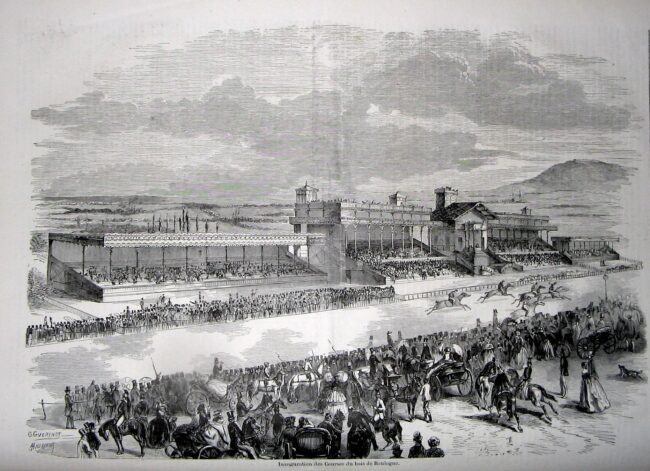
La course de 1857 avec les tribunes en bois, Le Monde illustré no 3. Public domain
There was an unimpressive track at the Champ de Mars, but the Jockey Club believed a new track would bring the French closer in stature to British horseracing. Thanks to the Duc de Morny, the club paid 50% towards the cost of the new racecourse, and a grandstand at the new Longchamp Hippodrome was built. The main architects for the hippodrome’s design were Antoine-Nicolas Bailly and Gabriel Davioud. As the chief architect of Paris’ Promenades and Plantations, Davioud not only designed many of the Bois de Boulogne’s chalets, gatehouses, and pavilions but also restored the ruined windmill, still seen today, as a vestige of the forgotten 13th-century Abbey of Longchamp.
What was not forgotten was the social hierarchy. Jockey Club members were leading bankers, entrepreneurs, statesmen, and military bigwigs. The tiers of the grandstand kept them front and center, as, over brandy and cigars, they used the racetrack to amalgamate politics and finances with sport.
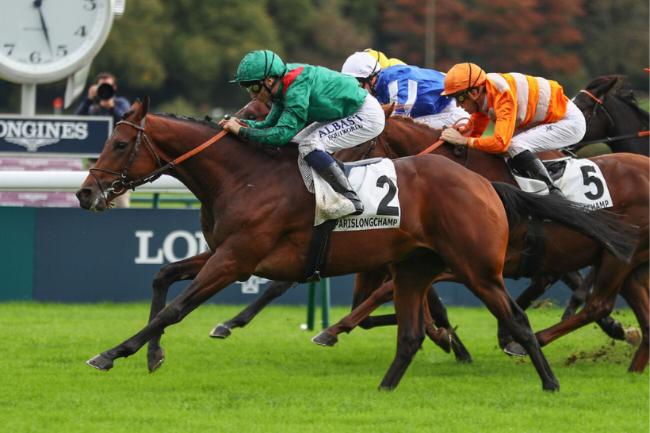
Longchamp racecourse, courtesy of France Galop
A large, eager mob was on hand for the first race at Longchamp held Sunday, 27 April, 1857. Napoleon III and his Empress Eugénie were present, having sailed down the Seine on the royal yacht. Reminiscent of the parade of athletes at the 2024 Paris Olympics, many elite Parisians traveled to the races by the river up until the 1930s.
As an active patron of horseracing, the emperor was even involved in drawing up the rules. French horses had begun winning major prizes and soon the races were pulling in crowds of thousands. Longchamp rose to international prominence in the decade that followed. The Duc de Morny finagled five leading French railway lines to underwrite the new Grand Prix de Paris. The inaugural race was to be held on May 31, 1863, but sacré bleu! – it was a Sunday. Initially the British competitors protested running a race on the Sabbath, but this didn’t deter eager English railbirds from crossing the Channel for the event. The purse for the first Grand Prix was 100,000 francs, and was won by a British-owned horse called The Ranger – a disappointment for Napoleon III who had his heart, and his money, set on a French colt named Le Touques.
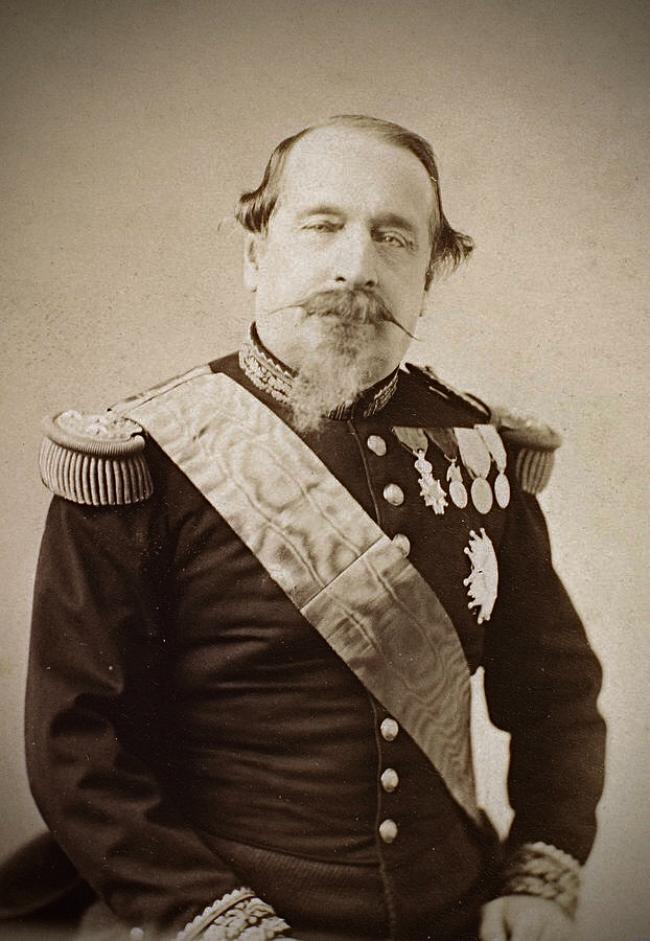
Napoleon III in uniform, 1870s. Photo: Augustin Aimé Joseph Le Jeune / Wikimedia Commons
Parisians, on horseback or drawn in carriages, turned the Avenue de l’Impératrice, now Avenue Foch, into a fashionable parade of old school rich. Promenading around the lakes of the Bois de Boulogne, they would rendezvous at the sumptuous Pré Catelan restaurant to recap the races. Longchamp’s prominence outweighed its short racing season, which was actually only a week in April, four days in late May or early June and an equally brief period in September. Balls and parties for the horsey-set were an important adjunct for the upper class and those climbing to reach it. The social aspect of the races kept couturiers, milliners, jewellers, even perfumers in business. Journalists and publishers had a new topic to devote column inches to.

Henri Alexandre Gervex, Une soirée au Pré Catelan, 1909. Wikimedia Commons
Before fashion shows were de rigueur, Longchamp was the precursor to Paris Fashion Week. The fashions debuted here were literally show stopping. Defying convention, some attendees to Longchamp were ladies without a customary male escort, who hovered on the fringes of respectable society. In the spring of 1908, three unaccompanied women walked onto the Longchamp grounds and stunned the crowd, wearing examples of haute couture hitherto unseen. Spectators thought their display was vulgar and accused them of being semi-naked (their dresses were extremely figure hugging) and flaunting their décolletage. The designs of these three dresses heralded the 20th-century silhouette. The designer Jeanne Margaine-Lacroix was not one for self-promotion but her lean, modern dresses spoke for themselves.
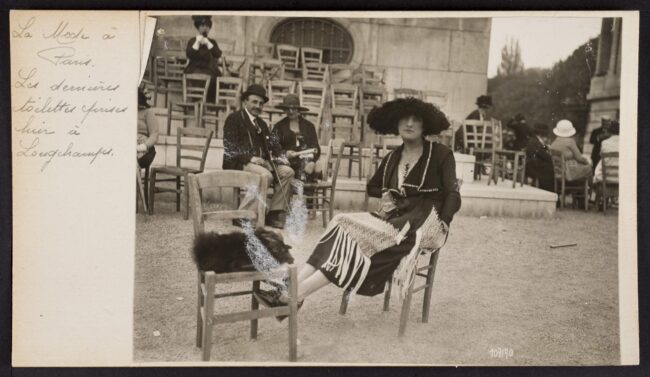
La mode à Paris. Les dernières toilettes prises à Longchamps. Public domain.
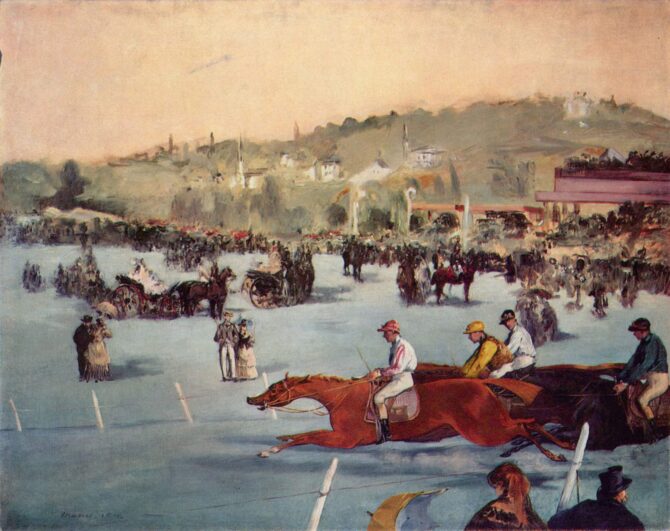
Degas, widely known for painting the ballet and café concerts, often chronicled the modernity of the horse track in the 1860s. Degas rarely focused on the track itself but with just a few dabs, painted the restlessness of the crowd. His deft shadows reveal the track at late afternoon as jockeys and their horses mill about in Le Défilé, 1866-68. Occasionally the irascible Degas and the dapper Manet attended the races together. Manet was present for the 2nd running of the Grand Prix de Paris. His pencil sketches made at the scene were turned into an oil painting called the Races at Longchamp, 1866. This striking and innovative work shows a finish line with the horses hurtling toward the viewer.
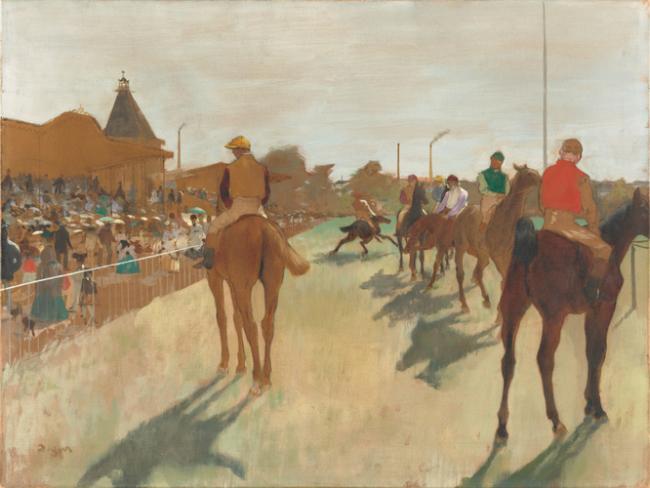
Edgar Degas, Le défilé, 1866-68
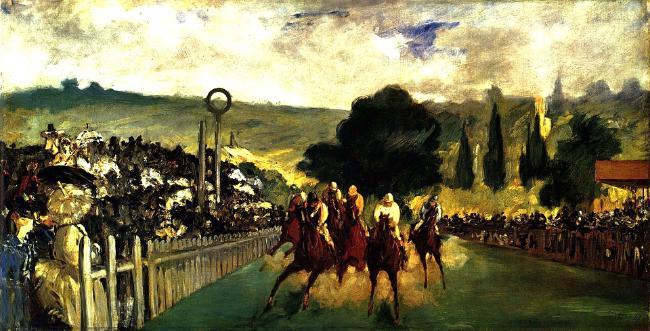
Les Courses à Longchamp, Édouard Manet, 1867
The track at Longchamp has played bit parts in literature. In Emile Zola’s 1880 novel Nana, he builds an entire chapter around a scene of the Grand Prix de Paris. Zola used Longchamp to represent the class-based segregation of racecourse life, all the while vividly representing the carnival atmosphere of race day. Flaubert intimately described a day trackside at Longchamp in his 1869 Sentimental Education, from the coconut sellers, to the jockeys in their silks, to the “grave-looking gentlemen” of the Jockey Club.
Longchamp’s reputation continued to grow during the early 20th century, but racing understandably halted at the outbreak of World War II. It resumed in 1941, during the German occupation of Paris, with a host of Nazi officers in the stands. In 1943 Longchamp was hit by a bomb during a race, killing seven. With fatal inaccuracy, the Allies aimed toward the Renault plant, then part of the Nazi war effort, but hit the nearby course. The bodies were cleared from the track, and racing and betting resumed just 90 minutes later at the crumbling course. An indicator of how war removes common decency.
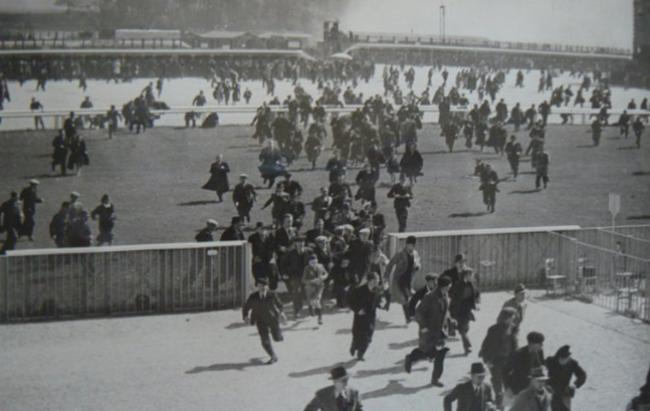
Bombing of the Longchamp race course, anonymous photo 1943
The American writer Ernest Hemingway was a skilled handicapper – one who analyzes and predicts the outcome of sporting events, and races – and, with a lucky chestnut in his pocket, had success divining the outcome of the races at Longchamp. He and his friends would finalize their picks at the Ritz Hotel. Hemingway could live off his trackside winnings for months.
Since 1920 the most prestigious horse race held at Longchamp, has been the Prix de l’Arc de Triomphe. Now sponsored by Qatar Racing, it’s commonly referred to as The Arc. Considered the true world championship of thoroughbred racing, this event brings together the globe’s finest horses and jockeys in one very lucrative race. As always, this year’s Arc is held on the first weekend of October. The premiere event is broadcast in more than 60 countries and watched by millions on screens. On site, ParisLongchamp will welcome upward of 35,000 spectators.
Longchamp was fully restored after the war, and racing continued until 2016, when it closed for two years, allowing FranceGalop to conduct a multimillion euro makeover. The architect Dominique Perrault, known for the design of the Bibliothèque Nationale de France, worked to outfit the buildings to a high standard of enviromental quality, by using geothermal energy, solar panels, the reuse of rainwater, and biodiversity in its landscaping which included nesting boxes for birds. It now has a capacity for 50,000 with room for 10,000 in the grandstands. The stands themselves offers a 360-degree view of the spectacle, but also views of the Seine and the city skyline.
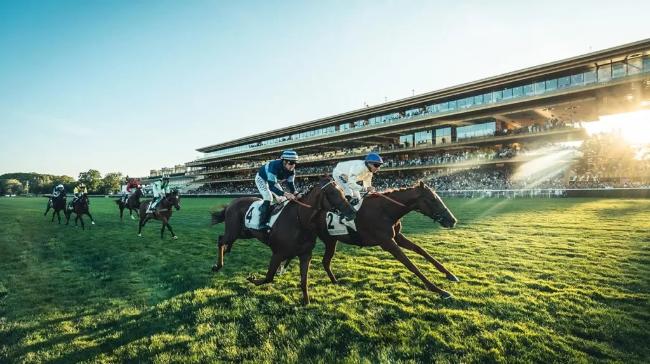
Paris Longchamp, courtesy of France Galop.
Everything old is new again. Paris kids are showing off their taste for old school society events held at Longchamp. Late teens and early 20s, attend trendy after work (or school) parties which combine the pounding of horses hoofs with the pounding of DJ sets, with jockeys both horse and music! It’s called JeuXdi by ParisLongchamp. Cleverly named, its 10 playful events held on summer Thursdays.
There is an annual music festival, which takes place at Longchamp at the end of June. It’s called Solidays and its proceeds go towards organizations fighting HIV/AIDS. Solidays was founded in 1999. Rock, pop, and hip-hop sets the tone over the three-day festival and welcomes over 200,000 attendees.
What to eat? In this exceptional setting, there is the tony trackside La Brasserie ParisLongchamp, as well a as wide selection of food trucks offering street food and world cuisine. There are two nearby auberges where one can eat and then there is the once-upon-a time hunting lodge, now Le Pré Catelan, which is a slice of gourmet heaven.
Apart from elite level sports, Longchamp offers many other garden parties, musical and charity events long after the betting windows have closed. For more information, visit the official website.
Lead photo credit : Courses au bois de Boulogne - Édouard Manet - 1872. Public domain
More in Bois de Boulogne, Hemingway, horse races
Related Articles