
Queen Anne of Kyiv and the Ukrainian Cultural Season in France


- SUBSCRIBE
- ALREADY SUBSCRIBED?
BECOME A BONJOUR PARIS MEMBER
Gain full access to our collection of over 5,000 articles and bring the City of Light into your life. Just 80 USD per year.
Find out why you should become a member here.
Sign in
Fill in your credentials below.
“Anna, a beautiful Ukrainian name. Welcome to Kyiv.” The border control official stamped my passport and beaming, handed it back to me. Not bothering to correct her – my name is Anne — I thanked her and passed through the barrier to join my husband and we were soon heading for Kyiv city center. This was August 2011, and we would end up staying until 2018.
Kyiv proved to be a fascinating, cultured city, not how I had imagined it. Any misplaced belief that Ukraine was not European and has always existed on the periphery of the European story was soon dispelled. I was struck by the number of international restaurants, especially French, and the reverence for anything French, from food to fashion to art, a fascination that I discovered can be traced down through a millennium.

Saint Sophia Cathedral, Kyiv. Photo credit: Rbrechko / Wikimedia commons
Almost a thousand years before, Anna — a tall, elegant, blonde Ukrainian princess of Scandinavian descent — was leaving this sparkling city of more than 400 churches to become the wife of Henry Caput, king of France, forming a bond between France and Ukraine stretching back into the depths of time. “Journey to Ukraine – Culture strikes back” has been an exceptional cultural season created by the Institut Français and the Ukrainian Institute, with the support of French and Ukrainian foreign and culture ministers, which since December has organized a program of over 50 cultural events and exhibitions taking place in cities across France: Paris, Marseille, Lille, Toulouse, Rennes, Caen, Valenciennes and Biarritz. The festival highlighting the inextricable union between France and Ukraine, created by that marriage that took place in 1051 in the cathedral at Reims, culminates in the closing event on March 28 at La Gaîté lyrique in Paris.
Pulling back the dust sheets covering the past reveals a marriage which explodes the belief that Ukraine is not European. The story of Queen Anne of France places Kyiv at the heart of the European saga. At a time when western concern for Ukraine sadly no longer takes precedence in headline news, it comes as a revelation for many to draw back the curtains of time and witness the stately marriage between Anna Yaroslava, the daughter of Yaroslav the Wise of Kyiv, and Henri I of France, consolidating a culture and spirit which has defined both Ukraine and France through the ages.
By delving into what is known of Anna’s life, we unearth unexpected insights into Ukraine’s medieval relationship with France and with the West. Through her essentially European heritage, Anna unites Kyiv with Europe. Not only were the future kings of France descended from her, but by extension of her family tree, kings of other European countries. Portrayed as captivating, intelligent and strong, she is a figure swathed in rumor and speculation. Many romanticizing stories have come down through the mists of time, and historians have differed in their opinions of what is myth or truth.
One thing is certain: by marrying Henry, she was stepping away from a sophisticated learning environment — steeped in Greek, science, maths and literature — to live in a country where many men, even alone women, were illiterate and intellectually inferior to her. She was well-educated and worldly-wise, the result of a courtly culture surrounded by Greek texts, translated by scribes, for her father, Yaroslav the Wise, who loved books and who undertook the building of the 13-domed Saint-Sophia cathedral in Kyiv. An icon of Kyiv, Saint-Sophia holds a fresco reputed to be an image of Anna, her father’s favorite daughter, symbolizing Anna’s religious as well as her Scandinavian heritage (her mother Ingerdad was the daughter of the first Christian king of Sweden). Stories of her father Yaroslav the Wise, referred to as Jarisleif the Lame in Norse Sagas because of an arrow wound he sustained in battle, are a reminder of Kyiv’s Viking origins.
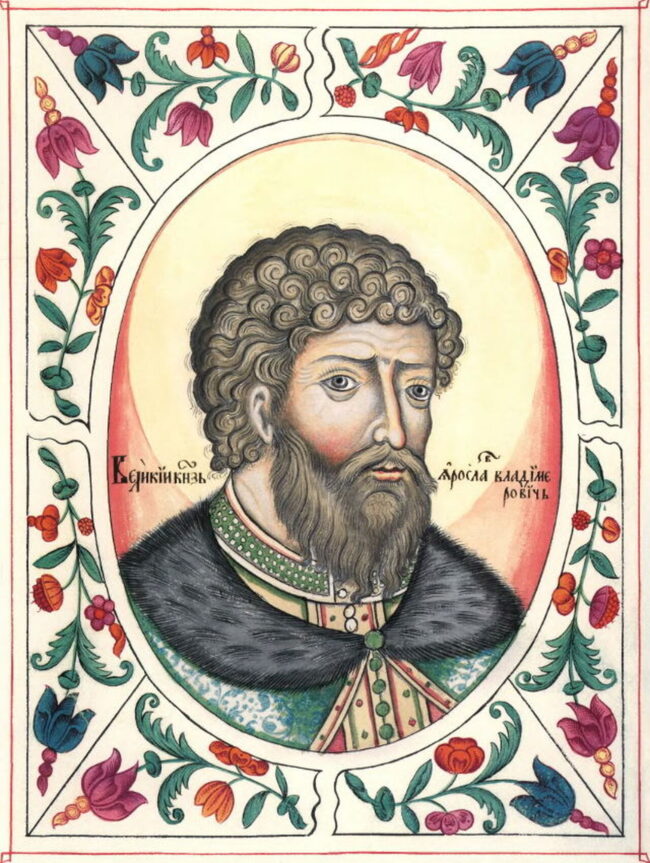
Portrait of Yaroslav the Wise in the Tsarsky titulyarnik (1672). Public domain
At this time, Kyiv controlled lands from the Baltic to the Black Sea. Anna was one of nine children and Yaroslav, who liked to call himself the father-in-law of Europe, was eager to improve relationships with the rest of Europe, especially the Byzantine Empire, by marrying his offspring to other heads of state. One of his sons married a daughter of the Byzantine emperor, and he arranged marriages for his other children with regents from Poland, France, Hungary, and Norway, as well as the Holy Roman Emperor. This move was emulated by Napoleon over 750 years later, by placing his brothers on the thrones of several European countries in order to consolidate his Empire.
In 1051, Anna was to make the most prestigious marriage of all. Following the death during childbirth of his first wife, Matilda of Frisia, Henri I was keen to marry again as soon as possible. After her father’s unsuccessful attempt to marry Anna to the German Holy Roman Emperor, she attracted the attention of the French king. After all, she was renowned throughout Europe for her exquisite beauty, intelligence and wisdom; she could read and write fluently in several languages, including Old Church Slavonic, Greek, Cyrillic, and Glagolitic alphabets. Most importantly for the Roman church, she was not related to Henri. She would make him the perfect wife, if she agreed to marry him, bringing prestige and also creating a tri-fold alliance between France, Poland and Kyivan-Rus against a growing German empire. Henri recognized her true worth, and consequently lost no time in sending an ambassador to Kyiv, laden with gifts in an attempt to make her his wife.
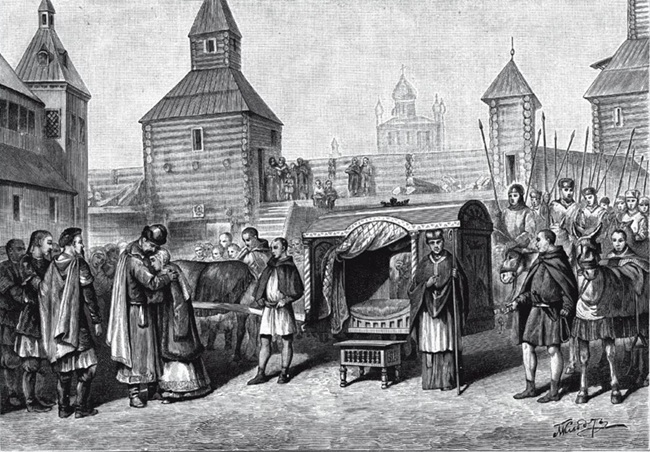
Princess Anna, daughter of grand prince Yaroslav the Wise, leaves for France to marry king Henry I. Public domain
Anna was probably around 20 years old when she married 43 year old Henri on May 19th 1051, a marriage alliance linking France’s Capetian dynasty with the ruling family of early Kyivan-Rus. Demonstrating her superior education, she signed the marriage contract with her own name, whereas Henri could only manage a cross. Legend has it that for her coronation vows, she used an ancient Slavic gospel which she brought with her from Kyiv, presumably part of her father Yaroslav’s library, rather than the traditional Latin Bible. Known as the Reims Gospel, it was said to be part of the cathedral’s museum — many French kings, including Louis XIV, swore their oaths on it. Any evidence is lost in the annals of time and the story is relegated to myth, but it’s now a priceless French national treasure.
Although bringing no lands as her marriage dowry, Anna brought great wealth and connections. Lasting only nine years, Anna and Henri’s marriage appears to have been a great success. Anna was an accomplished horsewoman, and when the eldest of her three sons was born in 1052, she introduced to France the Greek Orthodox name Philip, meaning “loves horses.” Philip succeeded his father as Philippe I and ruled for 48 years, marrying twice, firstly to Bertha of Holland and secondly to Bertrade de Montfort, having three children with each wife, perpetuating the future family tree of European kings.
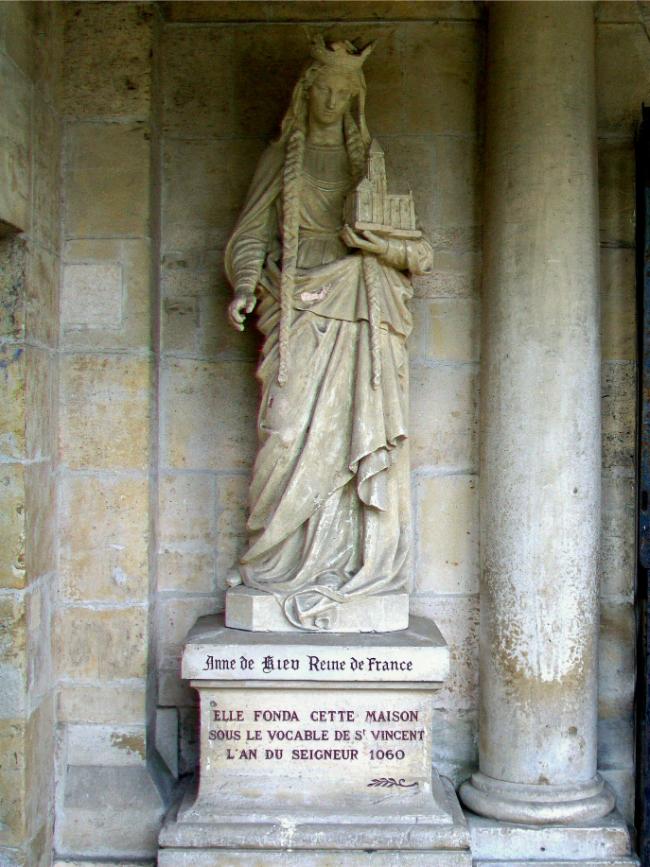
Statue of Anne of Kiev to the left of the portal at the Abbey of Saint-Vincent; the inscription dates the foundation to 1060. Photo credit: P.poschadel/ Wikimedia Commons.
Stories of Anna depict her as elegant, pious and graceful, viewing France as provincial compared with her civilized homeland of Kyiv. The queen would not have found it easy to adapt to French high society of that time. In unsubstantiated stories, she criticized poor French hygiene and illiteracy, turning up her nose at frog eating. She is reputed to have taught the French to use cutlery, and to have introduced bath houses to the people. Although supposedly complaining in a letter to her father about “the barbarous country, with its somber dwellings, horrendous churches and its terrible morals,” not everything was bad, as Anna appears to have made an effort to settle into her adopted country. She learned the language, and governed in partnership with Henri, a measure of the great respect the king held for his wife. Several decrees include the phrase “With the consent of my wife Anna” or “In the presence of Queen Anna.” French historians point out that there are no other cases in French history when royal decrees bear such inscriptions. She maintained her Cyrillic signature and was counter-signatory to at least four charters, including a 1058 charter of concession to the monastery of St Maur-les-Fosses, signed “including my wife Anna and sons Philip, Robert and Hugh,” and a donation to the monastery at Hasnon, which was signed by King Henri, Prince Philippe and Queen Anna.

Cathedral of Reims, where King Henri I was crowned. Photo credit: bodoklecksel / Wikimedia Commons
Anna of Kyiv was one of the few women in medieval times to successfully take up the reins of government. Following the death of her husband, when he was accidentally poisoned by an incompetent doctor, her statecraft proved crucial when she was called to rule as regent until her eight-year-old son Philippe was old enough to rule alone. Henri’s death was a dangerous moment making the realm precariously weak. His brother-in-law, Baldwin V of Flanders, father of Matilda of Flanders, Queen of England, was appointed regent, but Anna was held in high regard by so many, that the Bishop of Chartres described Philippe and his mother Anna as his sovereigns. As a child, Philippe ruled the kingdom jointly with his mother, who advised him and signed numerous royal acts. On one of the documents her signature is the oldest public example of old Ukrainian writing. She signed documents with the Cyrillic letters “Ана Ръина,” meaning “Anna Regina,” at a time of great illiteracy. There are at least 23 acts that mentioned Anna, or carried her signature, between 1060 and 1075. The Kyivan queen steadied the kingdom and Anna and Philippe I were referred to jointly as “the kings.”
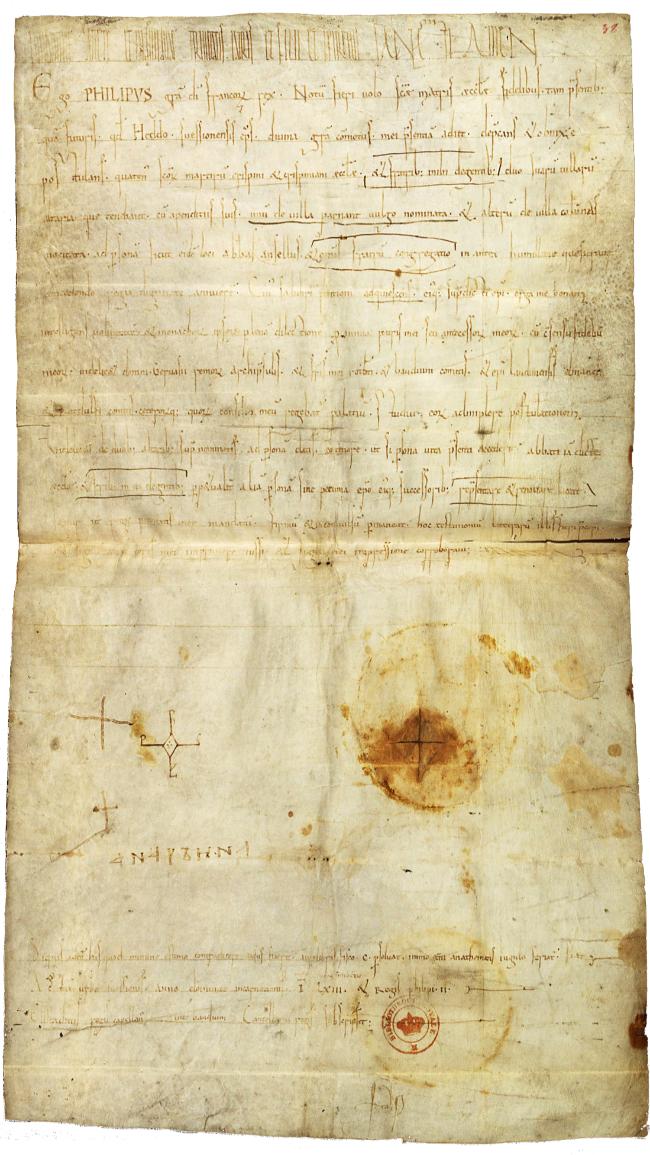
A charter signed on behalf of Anne and her son Philip in 1063. Credit: Bibliothèque nationale de France, Département des manuscrits/ Wikimedia Commons
Anna’s second marriage created a scandal when she fell in love with Raoul, Count of Crepy and Valois, who unfortunately was already married to Eleanor, whom he accused of adultery in order to marry Queen Anne. Eleanor, a woman scorned, went straight to the top appealing to Pope Alexander II, who ordered the Archbishop of Reims to investigate. Raoul refused to take Eleanor back, causing such an uproar that he and Anna had to leave court. As important allies of the king, they continued to advise Philippe, acting as signatories to his royal acts. Following Raoul’s death in 1074, the king welcomed his mother back to court. The date and place of Anna’s death are unconfirmed, but it is thought she died in 1075 and might have been buried at the Villiers Abbey at La Ferte-Alais.
In 2005, French President Jacques Chirac publicly acknowledged Anna as the “French queen from Kyiv.” She was the queen from the East who brought culture to France and proved that a woman could act wisely in politics, at a time when women were not expected, or allowed, to rule. Her image remains one of a wise and dignified queen.
Lead photo credit : Art historian Victor Lazarev presumed that the left-most figure on this fresco at Saint Sophia's Cathedral, Kyiv, represented Anne. Wikimedia Commons Public domain
More in Queen Anne of Kyiv, ukraine
Related Articles


By Anne Price