Espace Dali a Montmartre

By BP Editor  
"The world will admire me. Perhaps I'll be despised and misunderstood, but I'll be a great genius, I'm certain of it."—Salvador Dalí


It would be easy to walk right past the Salvador Dalí museum in Montmartre. It doesn’t look like much from the outside. Just a small storefront on a quiet side street a few steps away from the tourist mob of the Place du Tertre. But as with Dalí’s surrealist work itself, there’s much more going on below the surface.

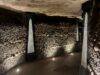
From the cramped entry, a long set of stairs leads down, down, down, past the basement and into a cavernous, black sub-basement. A large brass statue of a melting clock hung over a tree branch greets you. Welcome to the world of Dalí.

Or, at least, the world of Dalí later in his career. If you are looking for the large oil paintings from the 1930s that have made Dalí famous, what he called his "hand-painted dream photographs," you won’t find them here. The Espace Dalí museum is mostly filled with sketches, illustrations, and sculpture done by Dalí in the late 1960s and early 1970s. But for those who enjoy his earlier work, it’s an unexpected treat.

In these later works, we find a more mature Dalí. But rather than becoming more serious as he matured, Dalí become more playful. His sketches are light, loose, and full of movement and humor. Instead of the meticulously worked hyper-realism of his earlier paintings, here he experiments with integrating abstraction into his work. In a series of illustrations he did of Bible stories, "Sacra Biblia," he uses a technique called "bulletism," in which he would shoot ink at a canvas and then use the resulting blot as the basis for the sketch, working with pencil, ink and paint to give the random splotch a representational form.

Also in these later works, Dalí has had the time to distill his dream images and symbology down to their most potent forms and to play with them, making in-jokes to his earlier works, such as in his wonderful "Memories of Surrealism." The museum also features several large sculptures of some of Dalí’s more famous images, such as the Spatial Elephant with its long, multi-jointed legs and the crystal obelisk of future technology on its back.

The space itself is full of interesting surprises. One turn leads suddenly to an odd replica of the interior of a gothic church. Is this an installation by Dalí? No, actually it’s a remnant of a previous time in the building’s history when it housed a wax museum featuring famous people in the history of Montmartre. In this corner, a miniature replica of St. Pierre de Montmartre—the church on the other side of the Place du Tertre—was created out of plaster for displaying wax figures of the notables associated with the church. The Espace Dalí museum chose to leave the set intact and given Dalí’s interest in religious themes and the general surrealism of the place, it seems strangely appropriate. The back wall of the set, where the sanctuary is in the real church, features projections of Dalí’s work.

This year, in celebration of the 100th anniversary of Dalí’s birth, Boulangerie Poilâne has agreed to recreate this strange work. Tragically, Lionel Poilâne himself died in a helicopter crash in 2002, but his family continues the art of making bread, as well as making art out of bread. Beginning June 3, 2004, and running through September (or until it crumbles into crumbs) this bizarre recreation will be on display at the Dalí museum.

Practical Information
Written explanations of the works are provided in English, French and Spanish. Limited edition, hand-signed lithographs are available in a gallery of work for sale downstairs (prices range from 730 euros to over 9,000 euros, with the average price being around 2,000 euros) and a wide range of posters and other Dalí-inspired items are available in the gift shop upstairs. The museum can even be rented out for weddings and other private parties. Photographs are prohibited, but sketch books are highly encouraged.

Espace Dalí À Montmartre
www.daliparis.com
11, rue Poulbot, 75018
(Follow the signs from Sacre-Coeur or the Place du Tertre)
Hours: Open daily from 10 a.m. to 6 p.m. (July and August from 10 a.m. to 8 p.m.)
Tickets: 7 euros; reduced prices for seniors, students, and children


ADVERTISEMENT

COMMENTS

You must login to leave comments...

Premium Membership

Bonjour Paris is the Guide to Paris written by the top insiders in Paris. Join now and uncover all the secrets most American tourists will NEVER discover about Paris.

PARIS WITH KIDS GUIDE

Traveling to Paris with children? Our guide will show you all the best kid friendly places in Paris.